Three genuinely different methodologies for choosing between 2-4 options — not three variations on the same idea. Each works well when the others don't; the right one depends on what kind of decision you're actually facing. These apply just as well outside program management as within it — a vendor choice, a purchase, a hiring decision, or any multi-criteria call.
⚖️
Weighted Scoring Model
Weight your criteria, score each option against each one, and get a fast, transparent, defensible ranking.
Choose this when: you have a handful of clear, quantifiable criteria and want the simplest, most universally-understood method — the one most hiring managers and stakeholders already recognize.
Example: Choosing between three software vendors, weighing Cost (35%), Feature Fit (30%), and Timeline (35%). Score each vendor 1-10 on each dimension and get an objective ranking in minutes.
Open Tool →
🔍
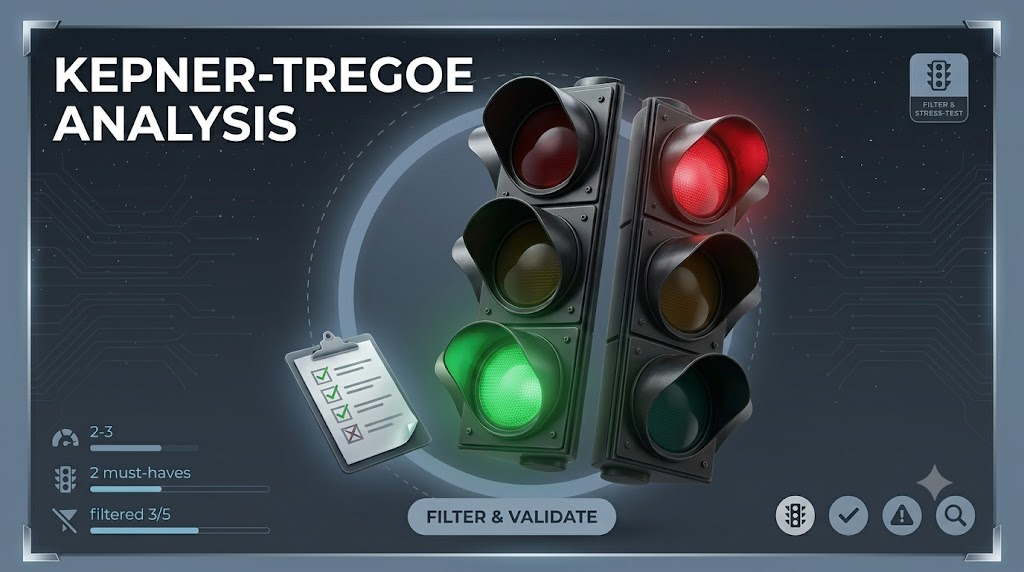
Kepner-Tregoe Decision Analysis
Filter out anything that fails a non-negotiable requirement first, rank what's left, then stress-test the winner.

Choose this when: some of your criteria are true dealbreakers, not just preferences — and you want a structured check on what could go wrong with the winning option before you commit.
Example: Hiring for a compliance role. "Must hold an active certification" and "must start within 30 days" are non-negotiable filters. Among candidates who pass both, weigh experience and fit — then check the top candidate against risks like a failed background check.
Open Tool →
🌴
Decision Tree (EMV)
Compare options whose outcomes are genuinely uncertain, by their probability-weighted expected value.

Choose this when: your options don't have one certain outcome — each could go a few different ways, with different odds and different payoffs or costs attached.
Example: Your company needs a new scheduling feature. Build it in-house, buy off-the-shelf software, or hire a contractor? Each path could go smoothly or hit problems, each with its own odds and net cost. Weighing all three by expected value shows which is the genuinely safer bet, not just the best-case story.
Open Tool →
📈
RICE Scoring
Reach × Impact × Confidence ÷ Effort — a formula built specifically for ranking product ideas by value per unit of work.

Choose this when: you're prioritizing product features or initiatives specifically, and want a formula that's multiplicative — a weak Confidence or high Effort can sink an otherwise-strong idea, the way real prioritization actually feels.
Example: Prioritizing three features for next quarter. A feature reaching 1,000 users/month with high impact and 90% confidence at 2 person-months of effort scores far higher than a niche feature reaching only 150 users, even if the niche feature "feels" important too.
Open Tool →
⚖️
Analytic Hierarchy Process (AHP)
Derive your criteria weights mathematically from head-to-head comparisons, with a built-in check for contradictory judgments.
Choose this when: you want more rigor than assigning weights yourself, or the decision is high-stakes enough that you want to catch it if your own judgments contradict each other.
Example: Choosing a car based on Cost, Safety, and Comfort. Instead of guessing "Safety is 40% important," you just answer "which matters more, Safety or Cost, and by how much?" repeatedly — the weights and a consistency check come out the other end.
Open Tool →
📏
TOPSIS
Ranks options by geometric distance from an ideal best-case and worst-case profile — and natively handles "lower is better" criteria like cost.
Choose this when: some of your criteria should be minimized, not maximized (like cost), and you want a more statistically robust ranking than a simple weighted sum.
Example: Comparing car models on Style, Reliability, and Fuel Economy (higher is better) against Cost (lower is better) all at once — TOPSIS finds whichever car sits closest to the theoretical best possible car across every dimension.
Open Tool →
⏱️
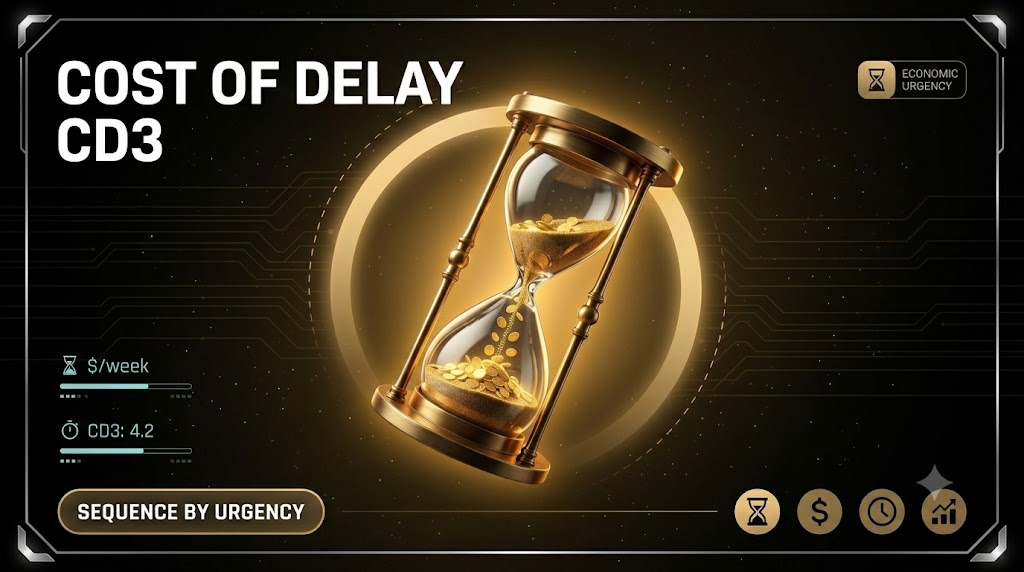
Cost of Delay / CD3
Cost of Delay ÷ Duration — sequences a backlog of committed work by economic urgency, not a pick-one decision.
Choose this when: the question isn't "which one should we do" but "what order should we do these in" — a genuinely different question than every other tool here.
Example: A program backlog with a big search-relevance improvement and a small checkout-flow fix. The smaller fix has a lower absolute Cost of Delay but finishes so much faster that it should still go first — CD3 makes that trade-off explicit instead of leaving it to gut feel.
Open Tool →