
← Drug Development Suite Authorize · Vitalis Therapeutics Inc.

Phase 3 Mobilization Kickoff

Download PowerPoint
20
Slides
4
Timescales
21.4
Years the widest one covers
Jun 2026
Speaks as at
Contents
  1. What a Kickoff Deck Is Actually For
  2. Four Timescales, Because One Is Misleading
  3. The Slides
  4. The History Section, and Being Honest In It
  5. Point-in-Time Discipline
  6. What Building It Caught

1. What a Kickoff Deck Is Actually For

This deck was given at Gate 4, 30 June 2026 — the mobilization of Stage 4, which is 58% of the program's budget and the point at which 260 investigational sites, a contract research organization, a contract manufacturer and a central laboratory all begin work at once.

It is not a status report and it is not a plan document. Both of those exist elsewhere. What this deck does is answer a question that no other artifact in the suite answers: why is this program happening at all, and how did it come to look like this?

Read byWhy they need it
The room on the dayProgram team and partner leadership, mobilizing together. They need alignment, not information — most of them already know the program.
People who watch the recordingThose who could not attend. They get the words but not the room, so nothing can depend on being present.
Somebody reading it cold in month nineThe audience the deck is actually written for. A data manager joins in month nine, is pointed at the initiation package, and needs to understand not just their slice but what the program is about.
A new manager taking over a functionWants to know what was decided, when, and on what basis — before changing anything.
The third audience is why this deck is written in paragraphs rather than bullet fragments.

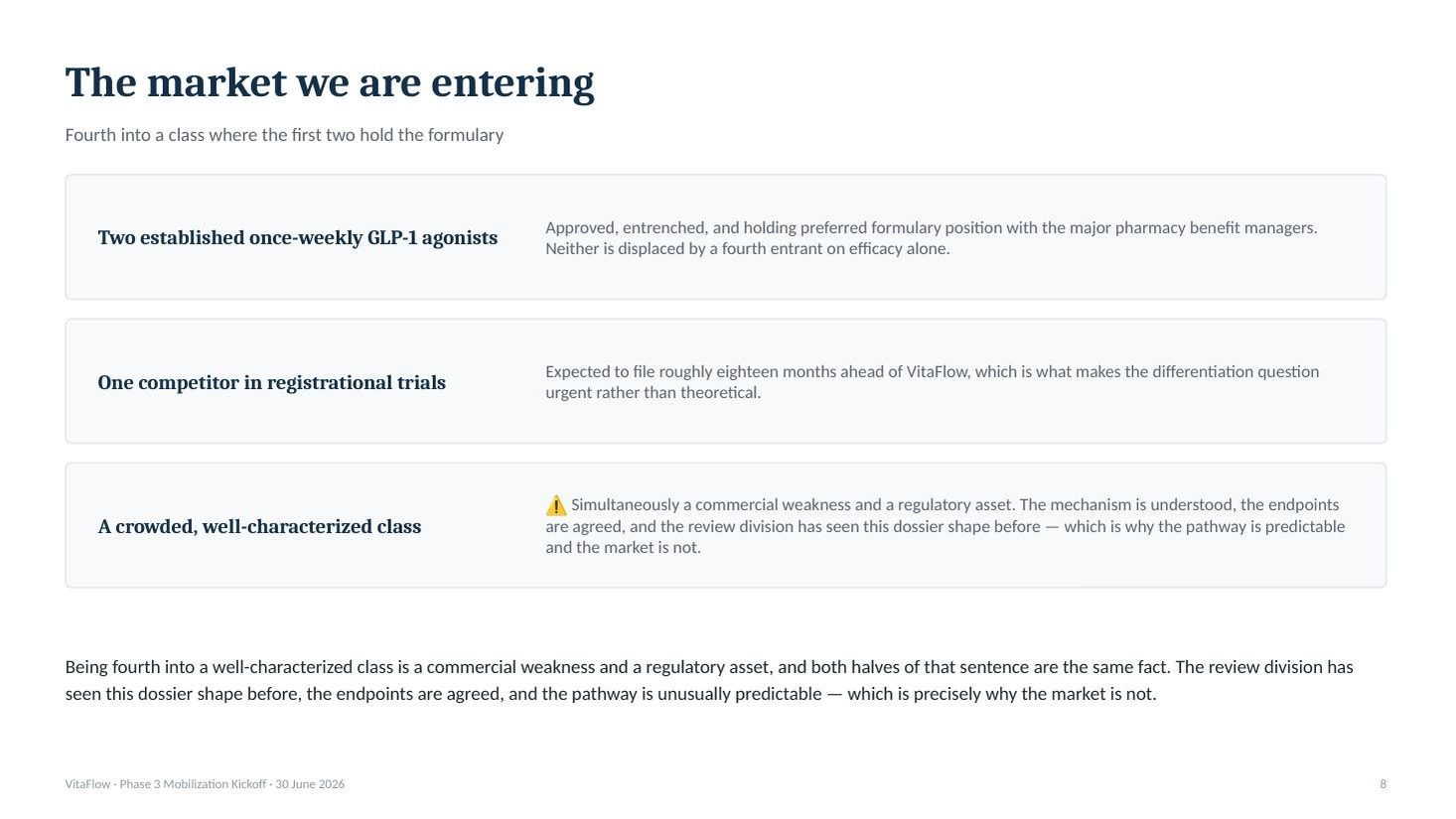
A slide reading “• Crowded class” is a prompt for a presenter standing next to it. To someone reading alone in month nine it conveys nothing. The paragraph version — that VitaFlow is fourth into a class where the first two hold preferred formulary position, which makes tolerability differentiation load-bearing rather than nice to have — tells that reader why the target product profile looks the way it does.

A kickoff deck has a longer readership than any other document a program produces, and it is read by more people who were not there than people who were. Optimizing it for the twenty minutes it is presented is optimizing for the smallest part of its life.

2. Four Timescales, Because One Is Misleading

The most common confusion about a program like this is where it begins. The answer is non-obvious, so the deck answers it four times at four different resolutions.

TimescaleSpanWhat it settles
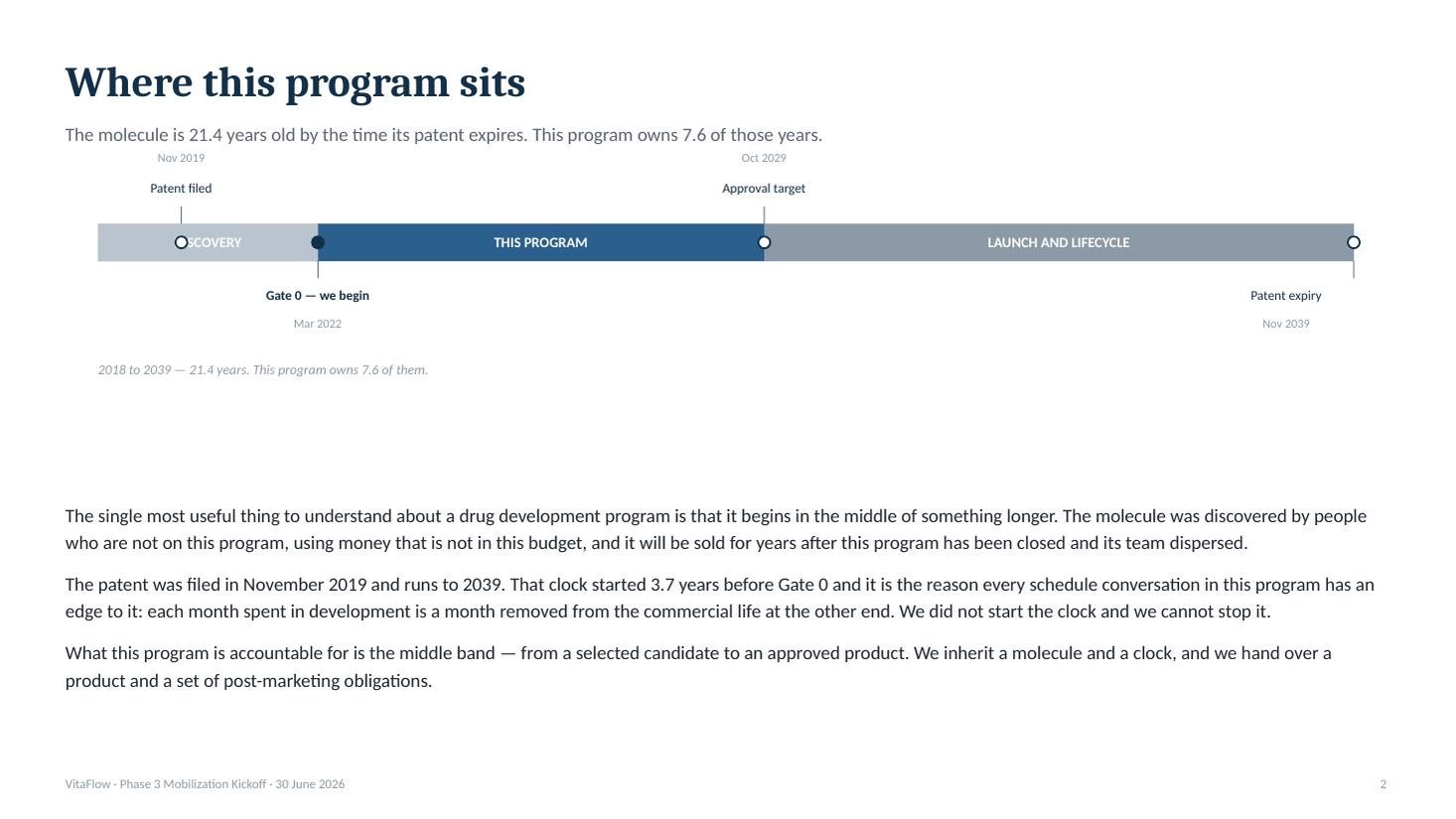
1 — The molecule2018–2039 (21.4 yrs)That the program starts in the middle of something longer. We inherit a molecule and a patent clock we did not start, and hand over a product we will not sell.
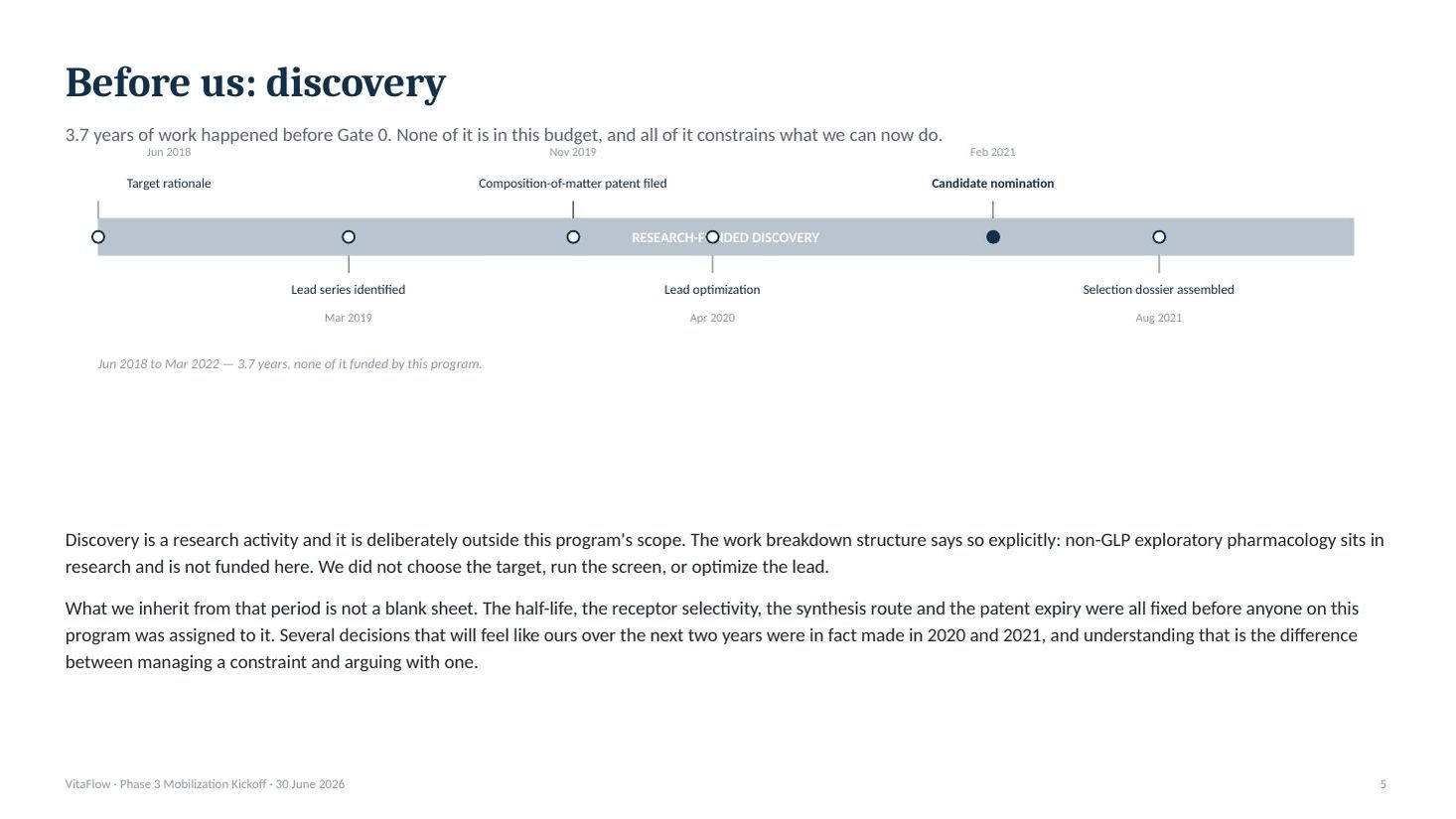
2 — DiscoveryJun 2018–Mar 2022 (3.7 yrs)What happened before Gate 0 and why the molecule has the properties it has. Deliberately low resolution — it is context, not scope.
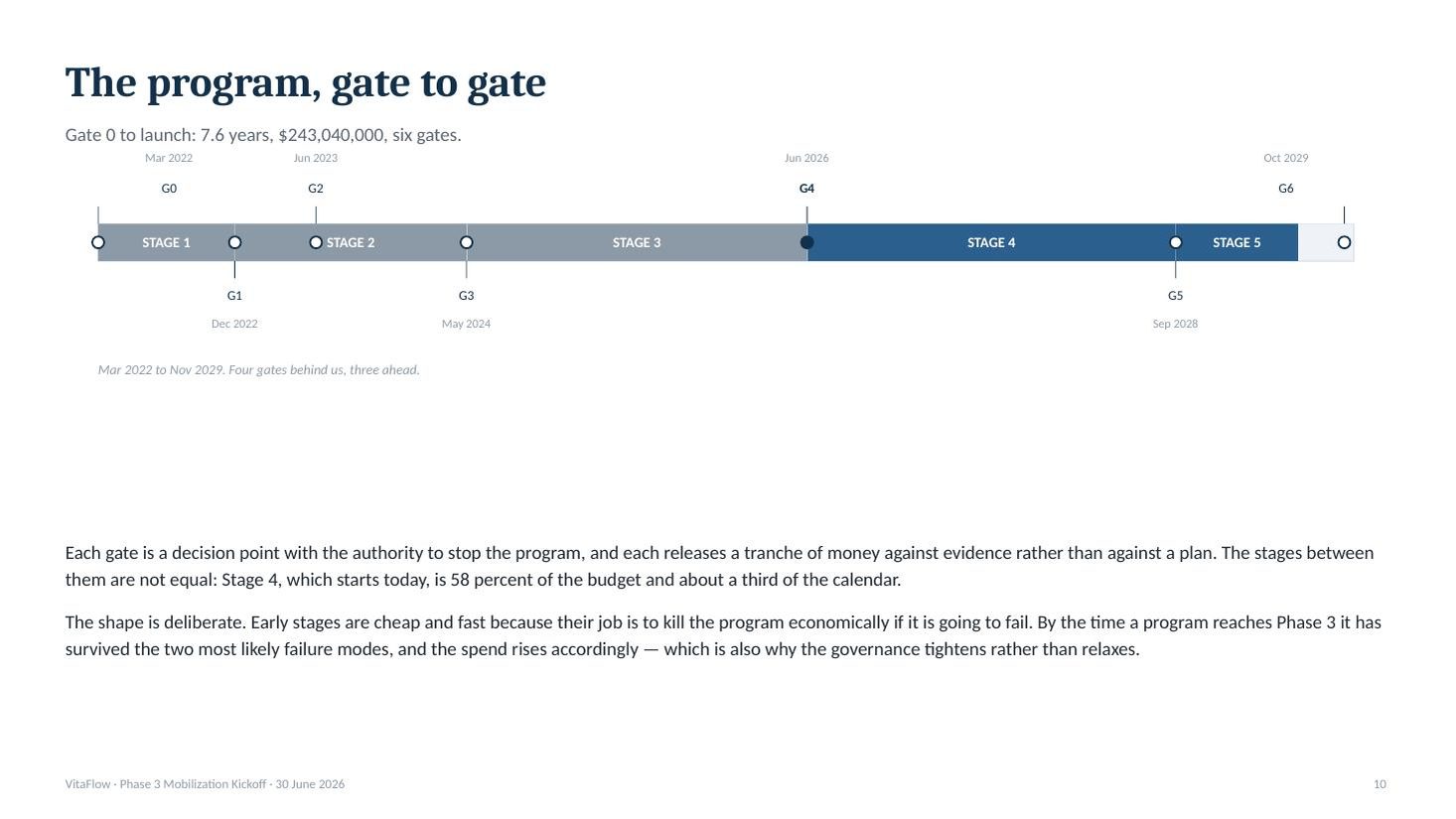
3 — The programMar 2022–Nov 2029 (7.6 yrs)The six gates, the five stages, and the fact that Stage 4 alone is 58% of the budget.
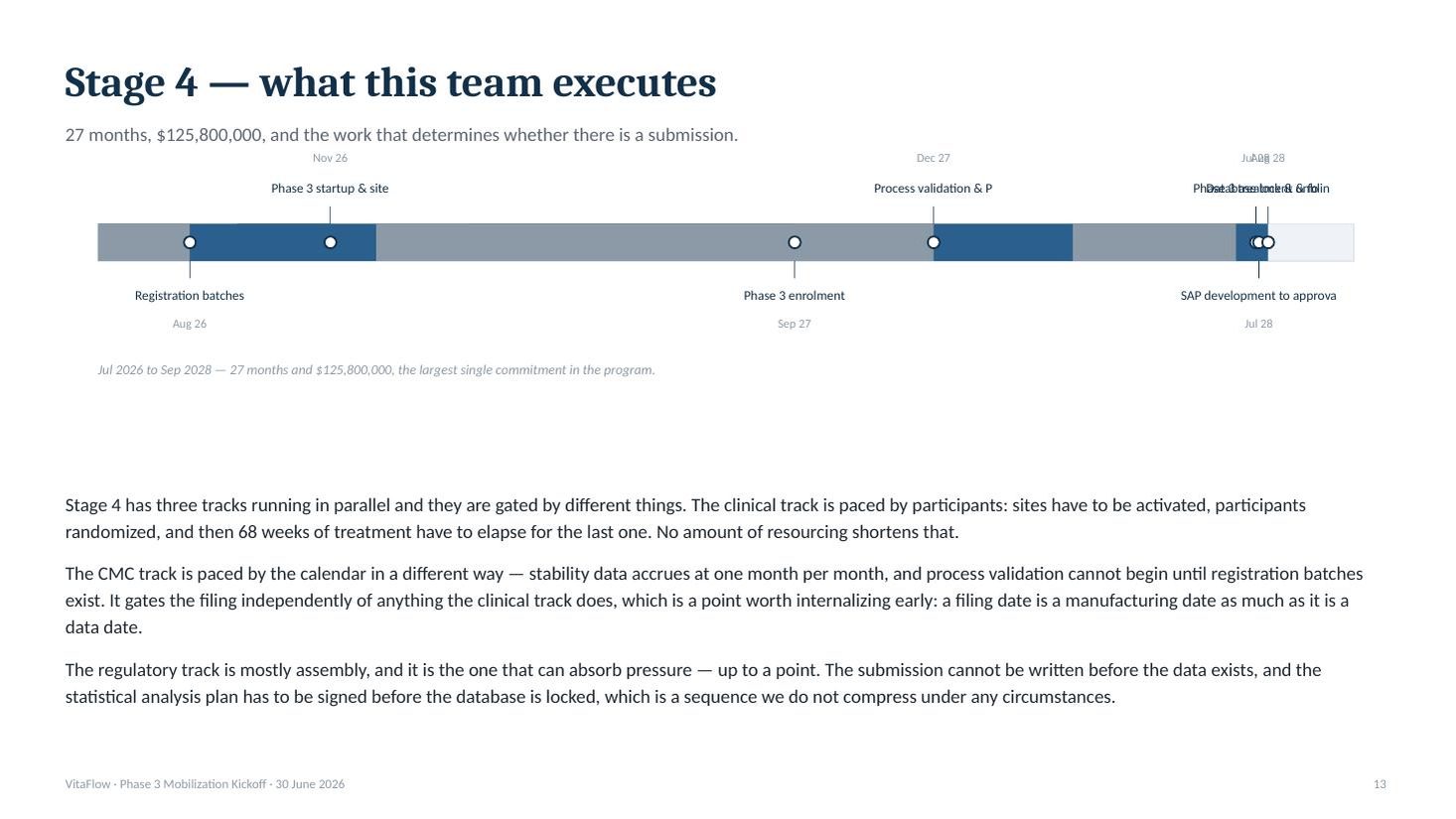
4 — Stage 4Jul 2026–Sep 2028 (27 months)What the people in the room actually execute, with the three parallel tracks and their different pacing constraints.
A single timeline would have to choose a resolution, and every choice is wrong for somebody.

At twenty-one years the program is a band and Stage 4 is invisible. At twenty-seven months the patent clock is off the page and nobody understands why schedule matters so much. The four scales are not repetition; each answers a question the others cannot.

All four are drawn by the same renderer from the same date facts, so they cannot disagree with each other or with the integrated schedule.

3. The Slides

#SlideWhat it carries
1TitleProgram, stage, date.
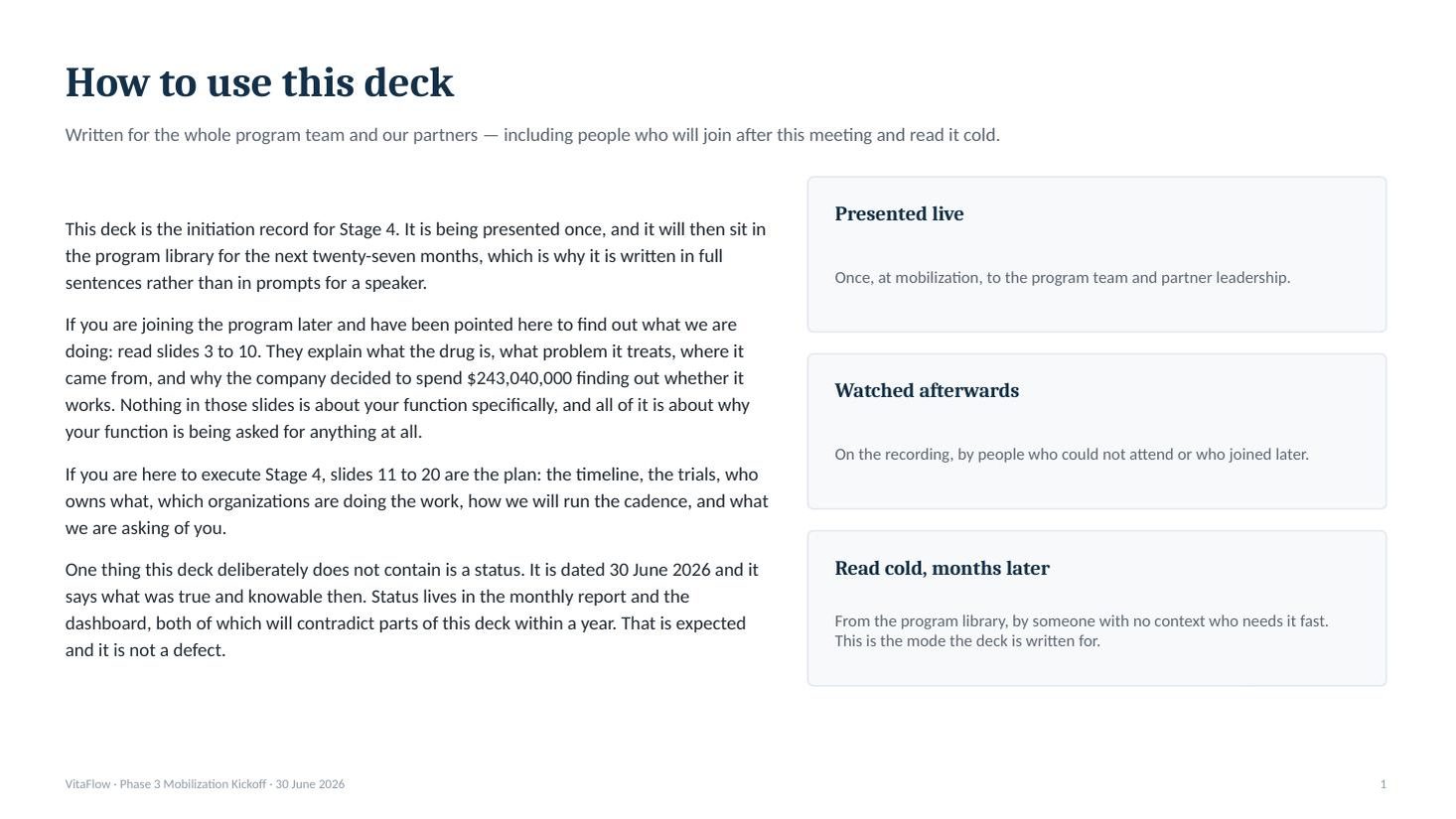
2How to use this deckWho it is for, and the three modes it is read in.
3Where this program sits⏱ TIMESCALE 1 — the molecule's 21.4-year arc.
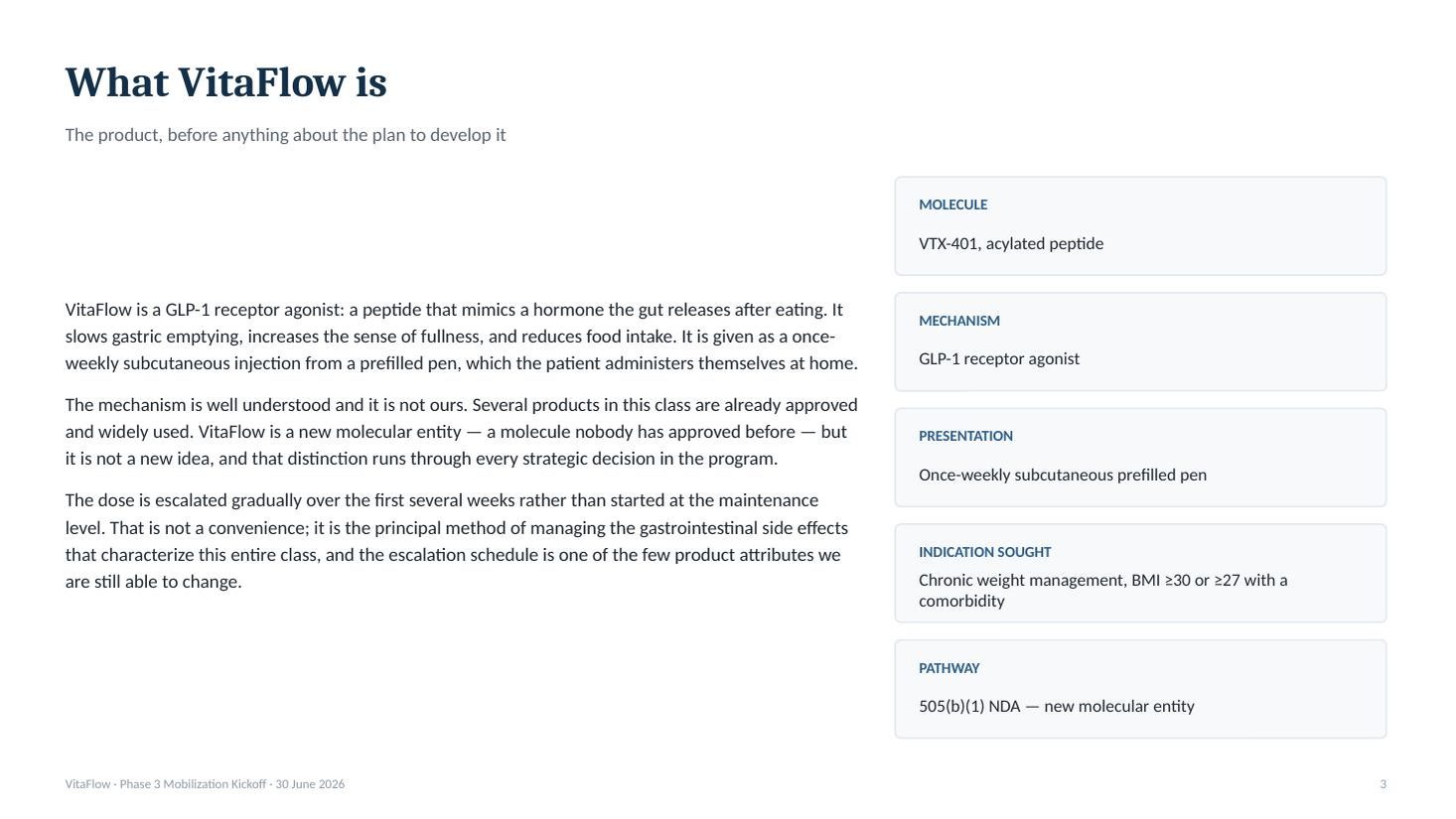
4What VitaFlow isThe product, before any plan to develop it.
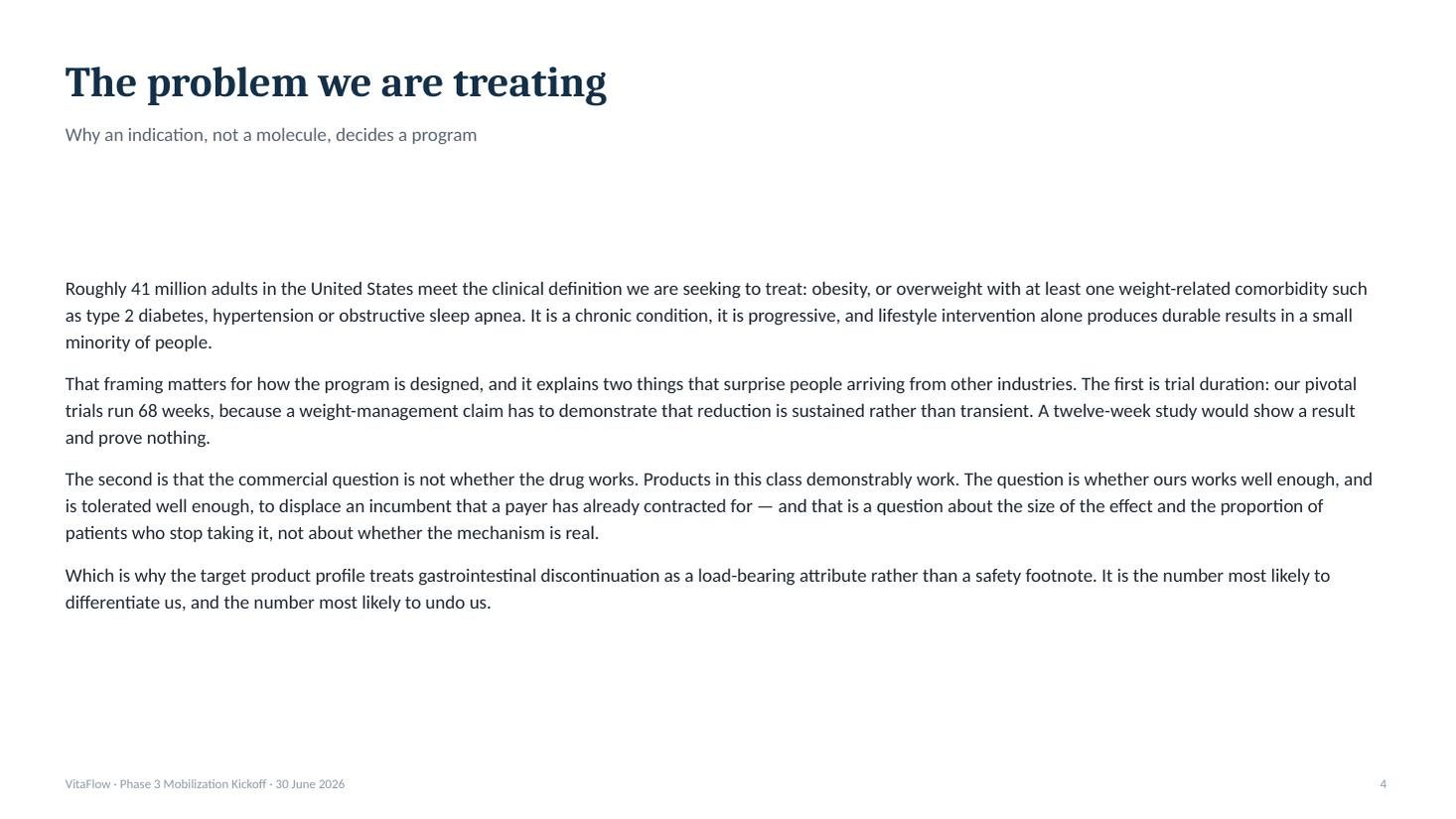
5The problem we are treatingWhy the indication decides the trial design.
6Before us: discovery⏱ TIMESCALE 2 — 3.7 years that predate the program.
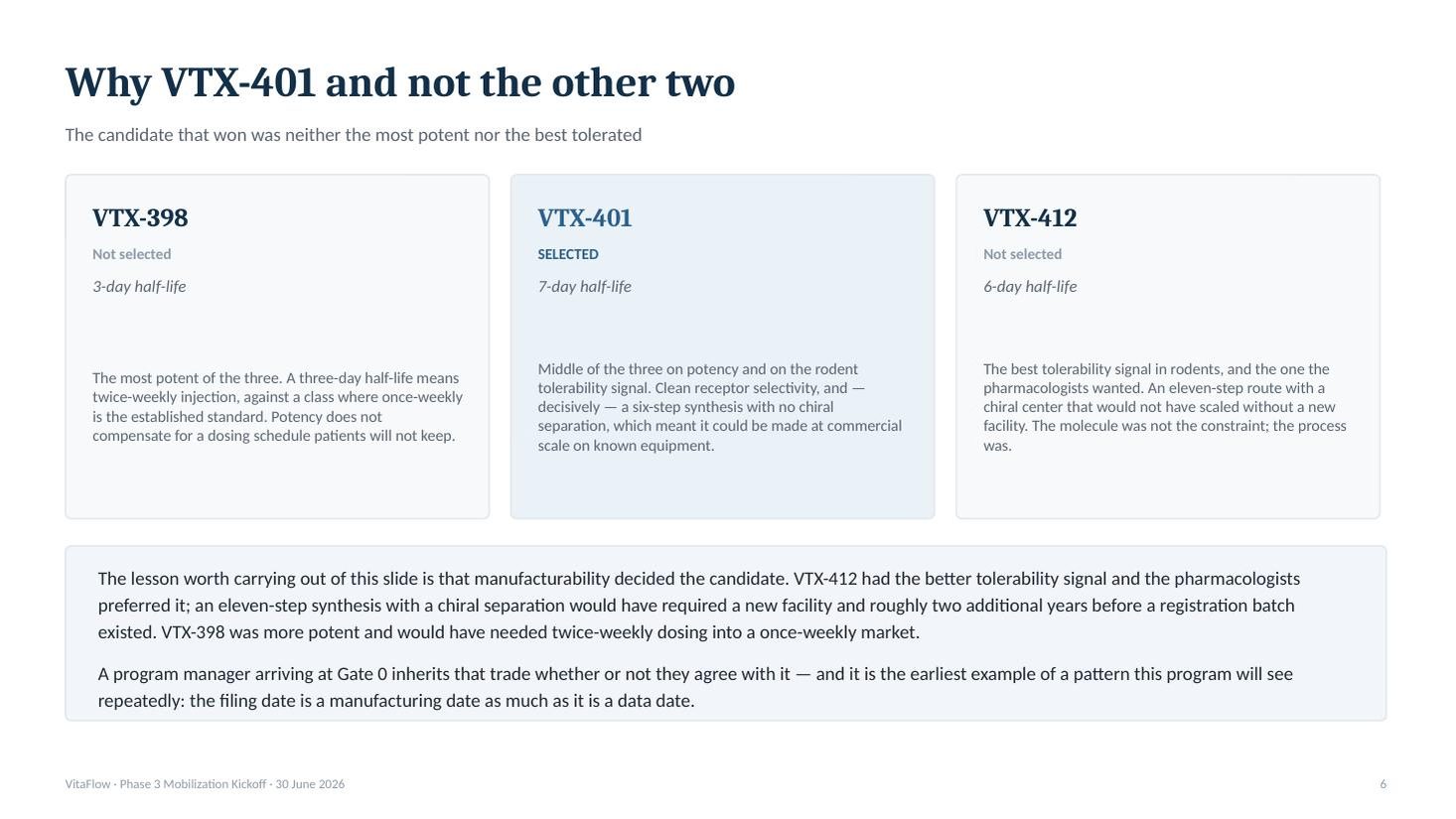
7Why VTX-401Three candidates; manufacturability decided it.
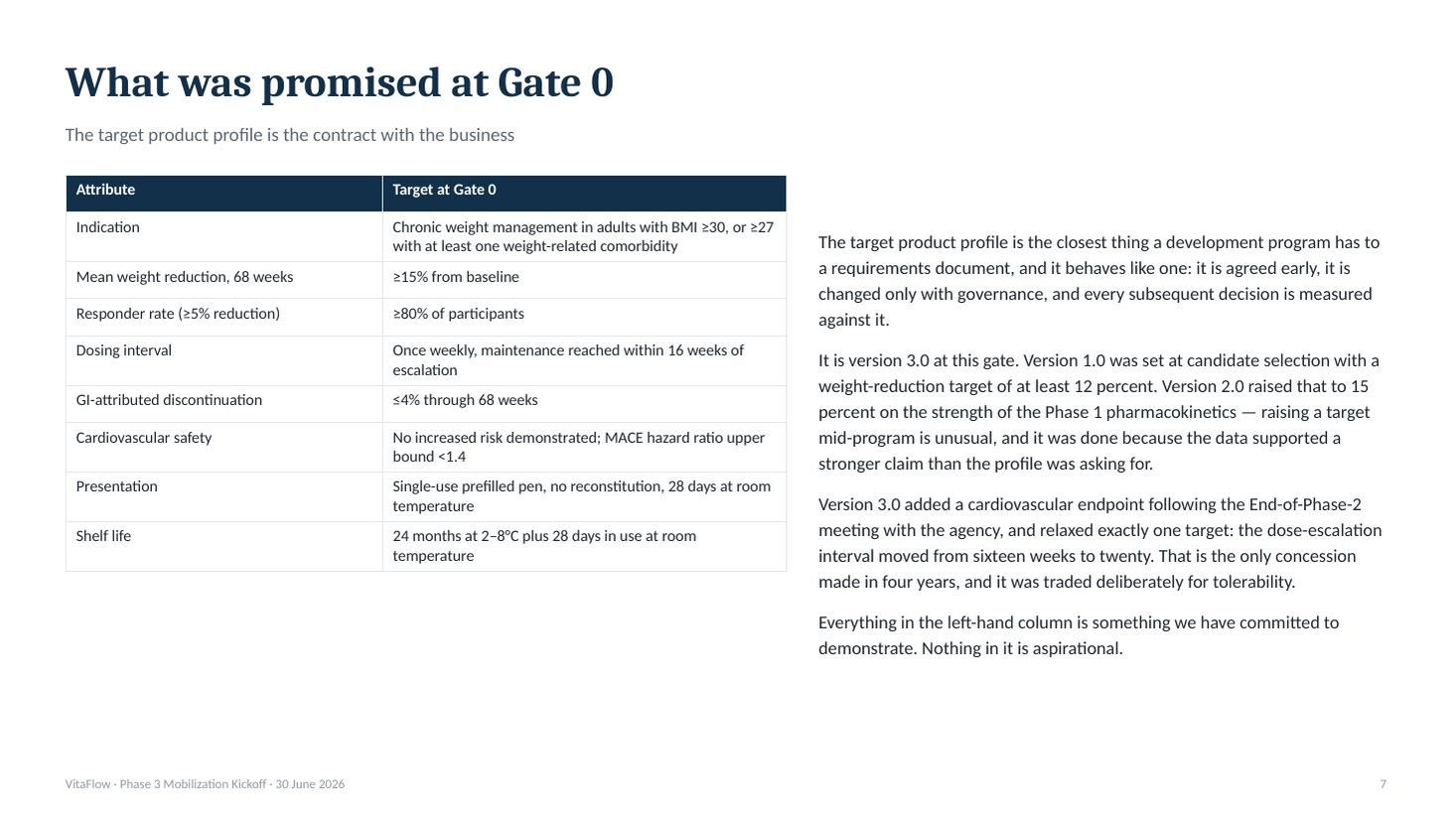
8What was promised at Gate 0The target product profile as a requirements document.
9The market we are enteringFourth into a class; weakness and asset in one fact.
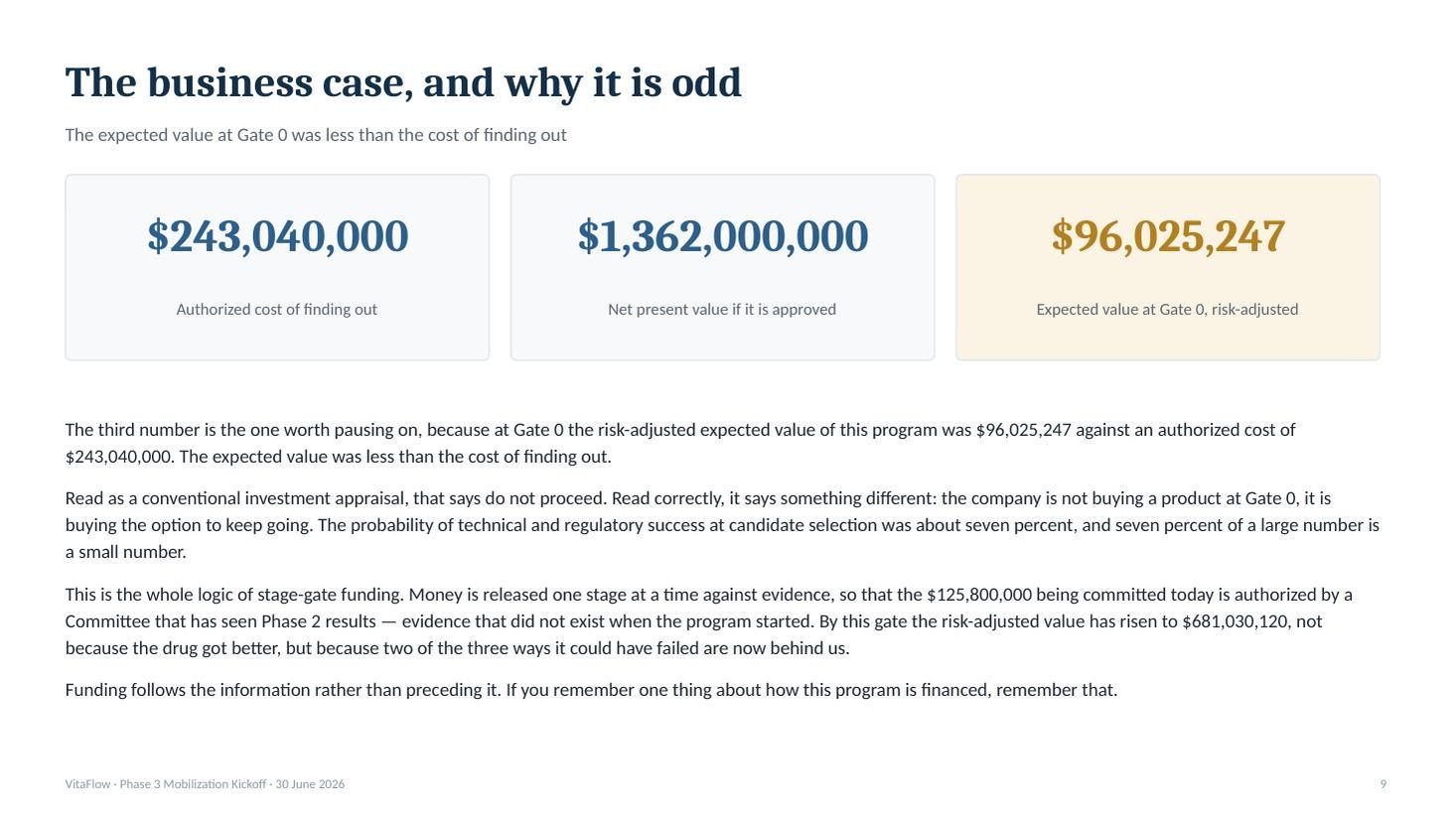
10The business caseExpected value below the cost of finding out.
11The program, gate to gate⏱ TIMESCALE 3 — six gates over 7.6 years.
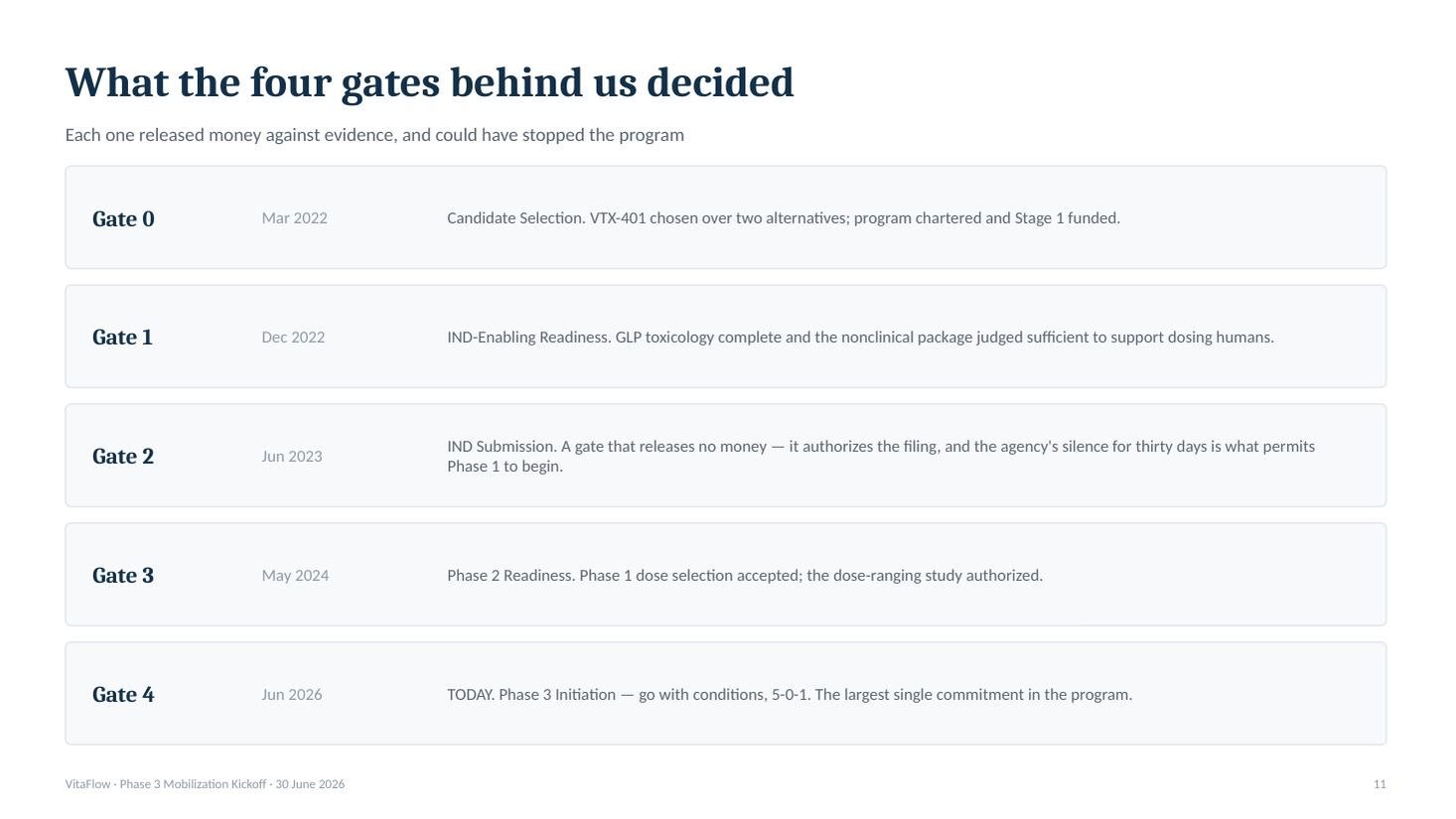
12What the four gates decidedReference for the read-later audience.
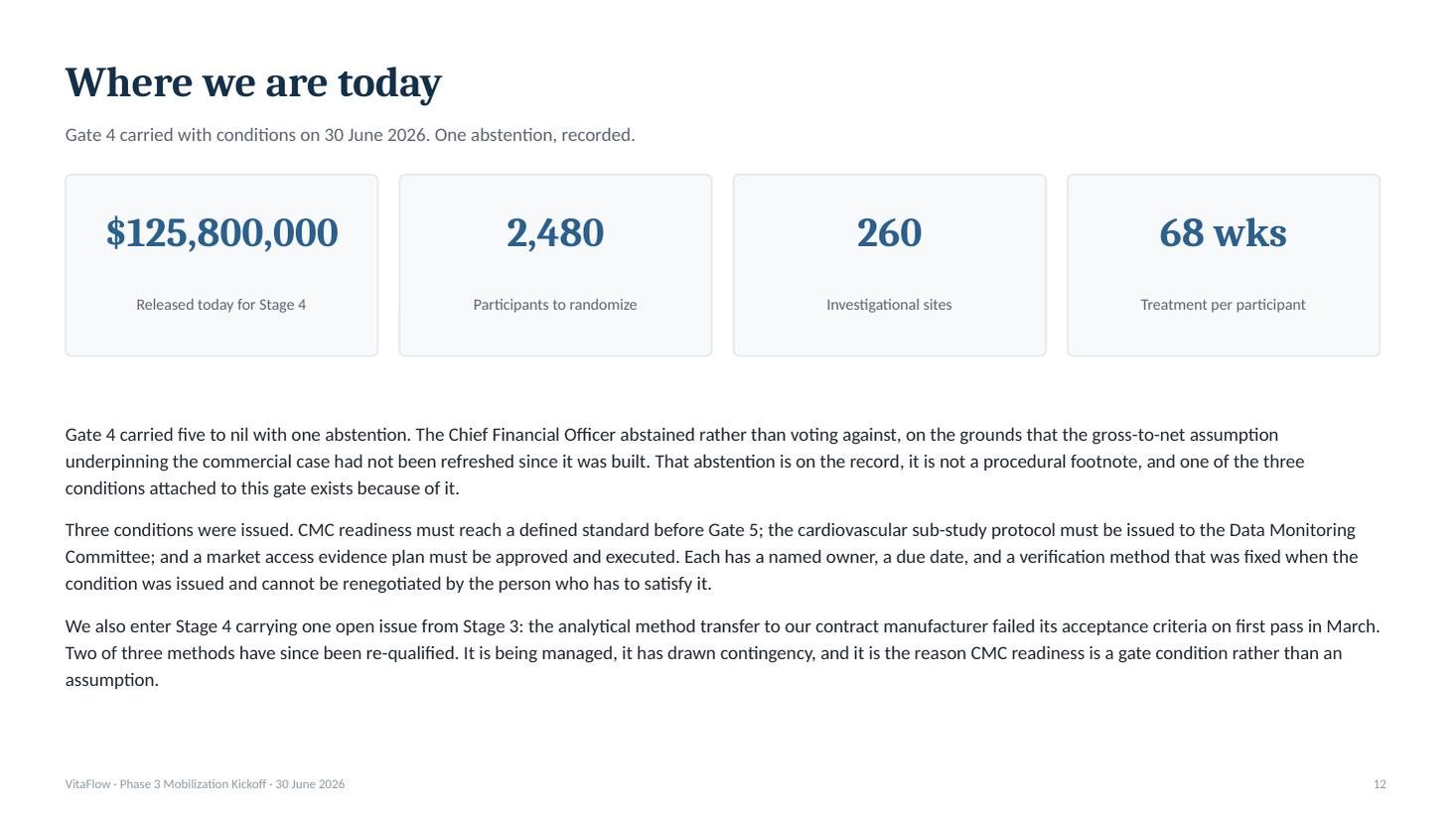
13Where we are todayGate 4, its conditions, and the recorded abstention.
14Stage 4⏱ TIMESCALE 4 — 27 months, three parallel tracks.
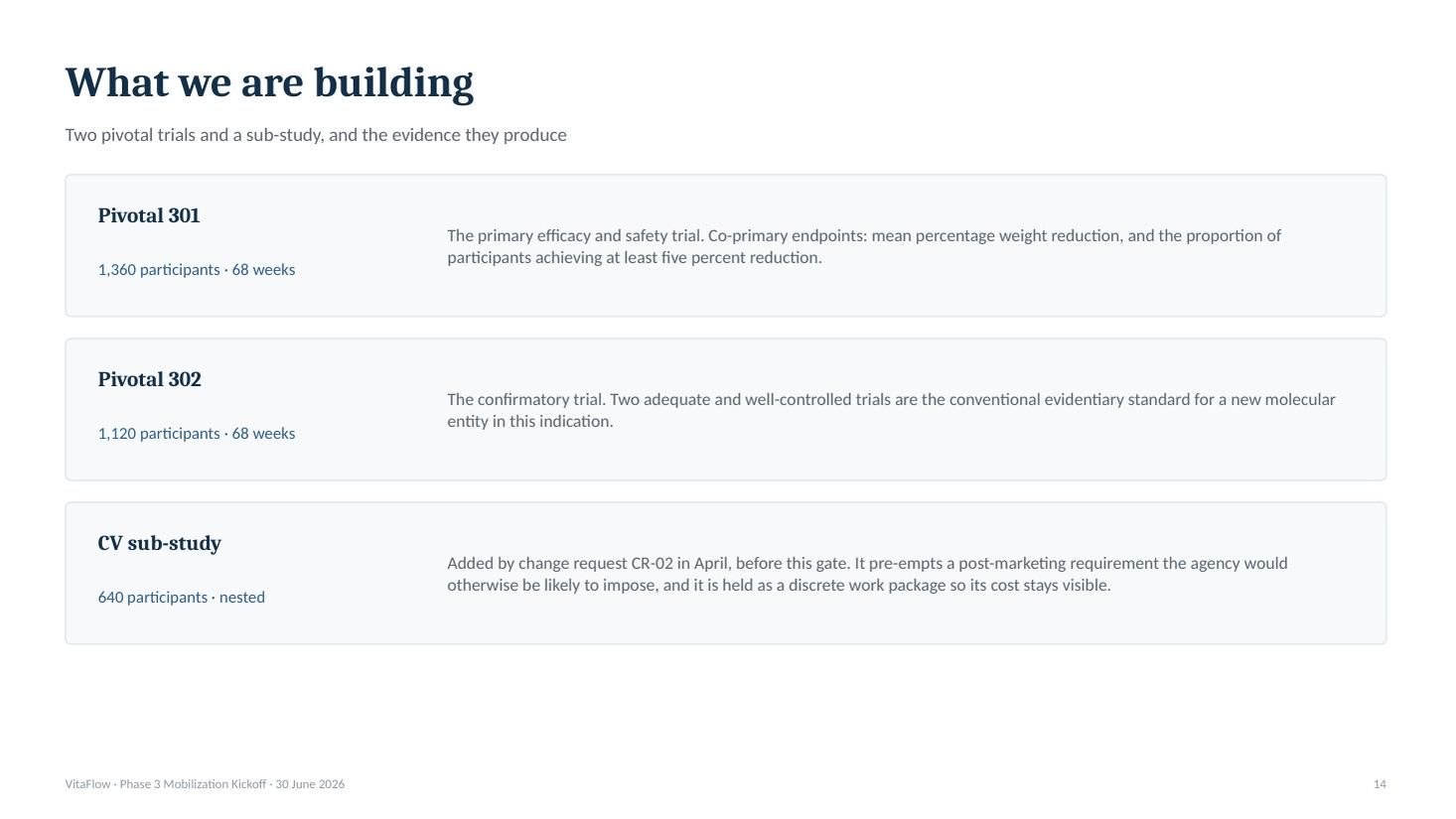
15What we are buildingTwo pivotals and a sub-study.
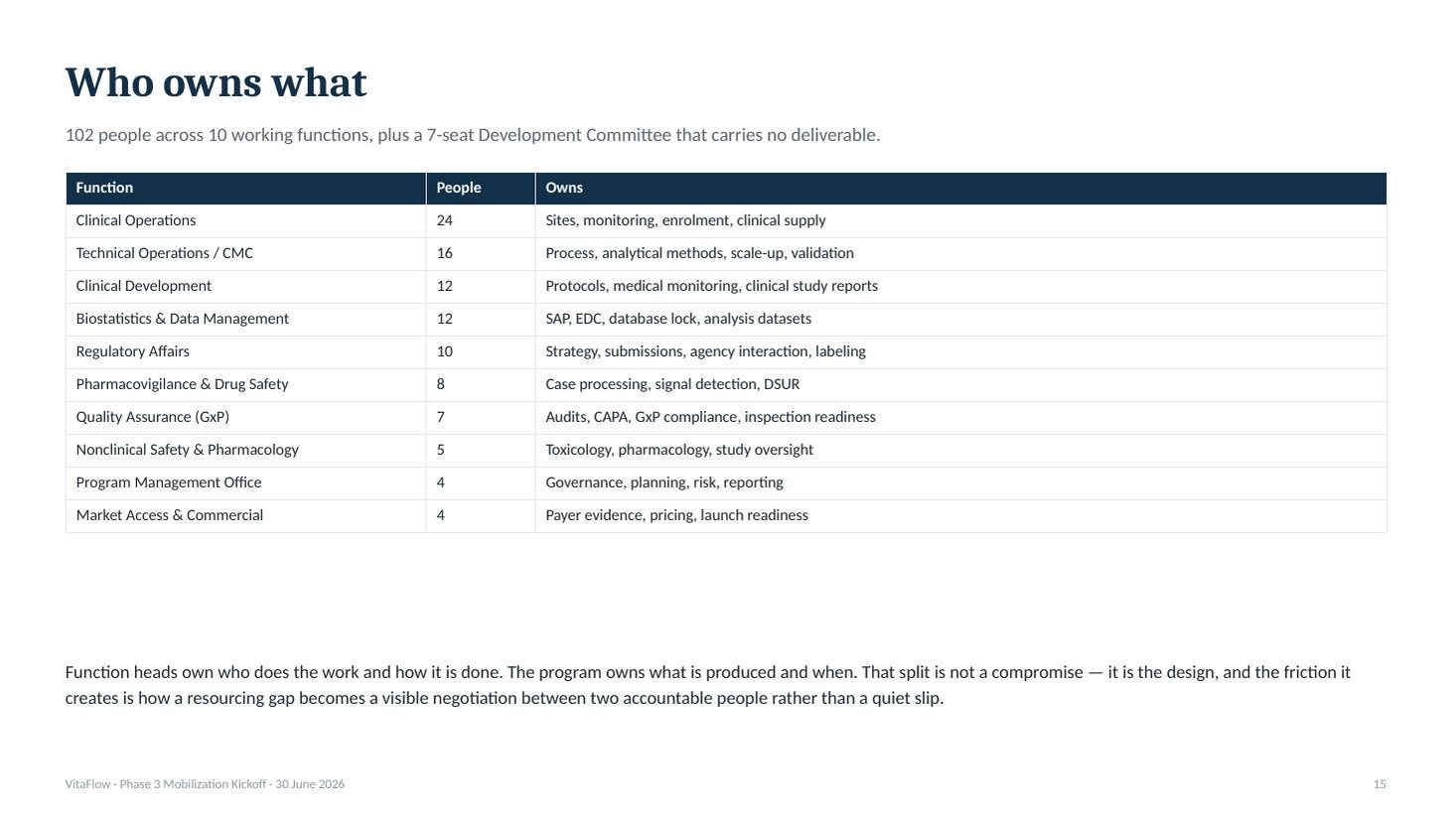
16Who owns whatTen functions, and the matrix split.
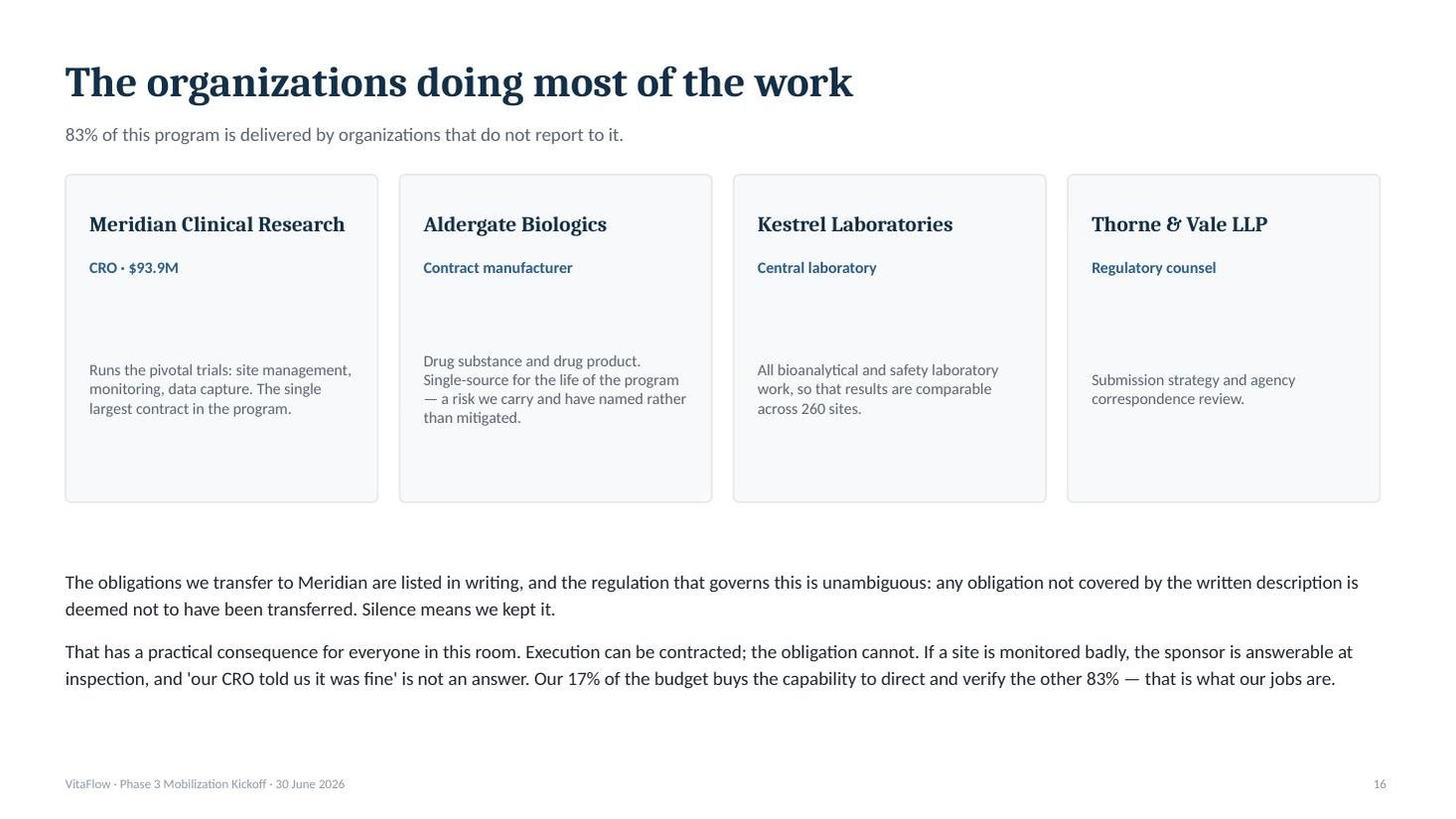
17The organizations doing the work83.4% external, and what that obliges.
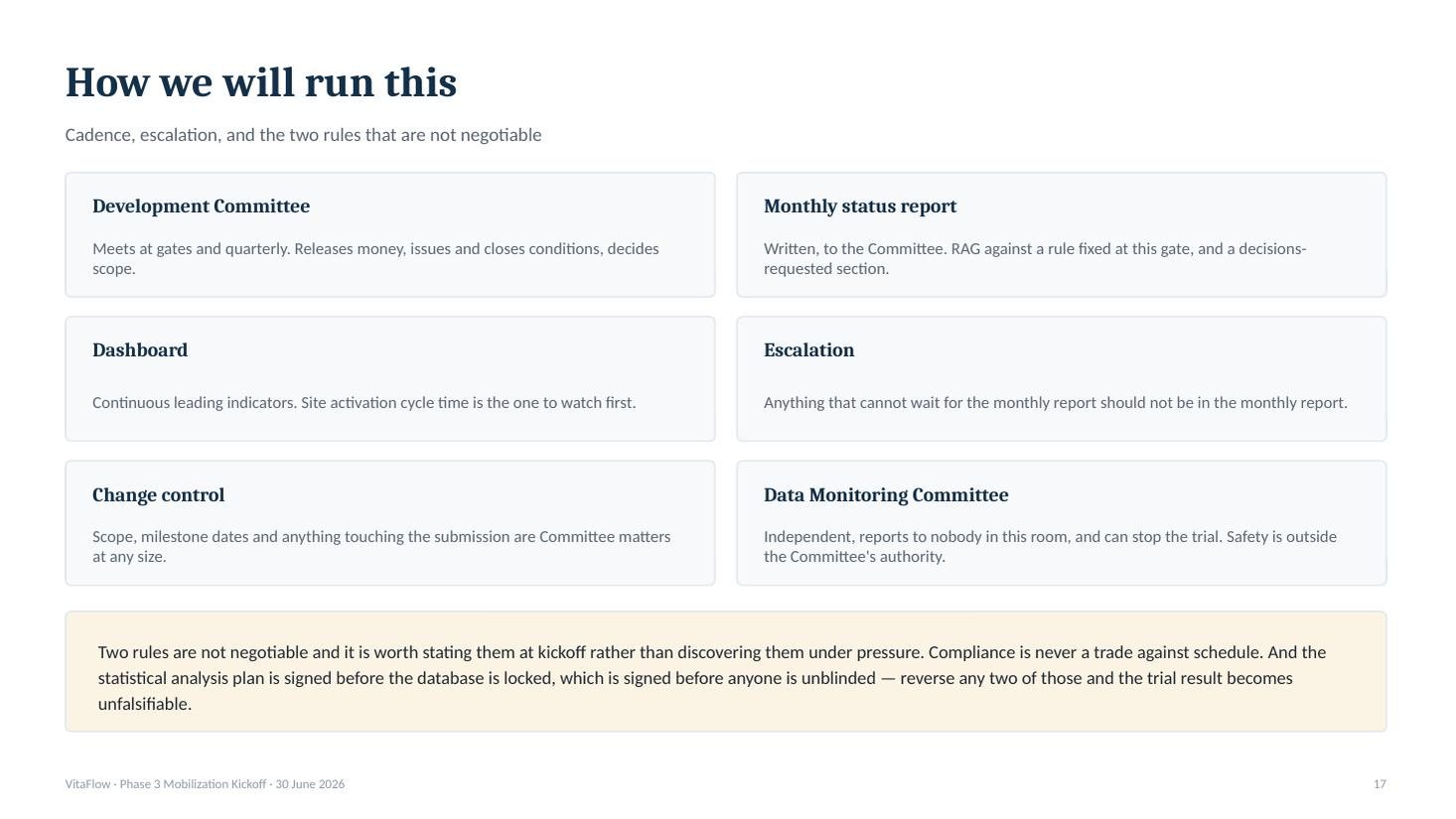
18How we will run thisCadence, escalation, two non-negotiables.
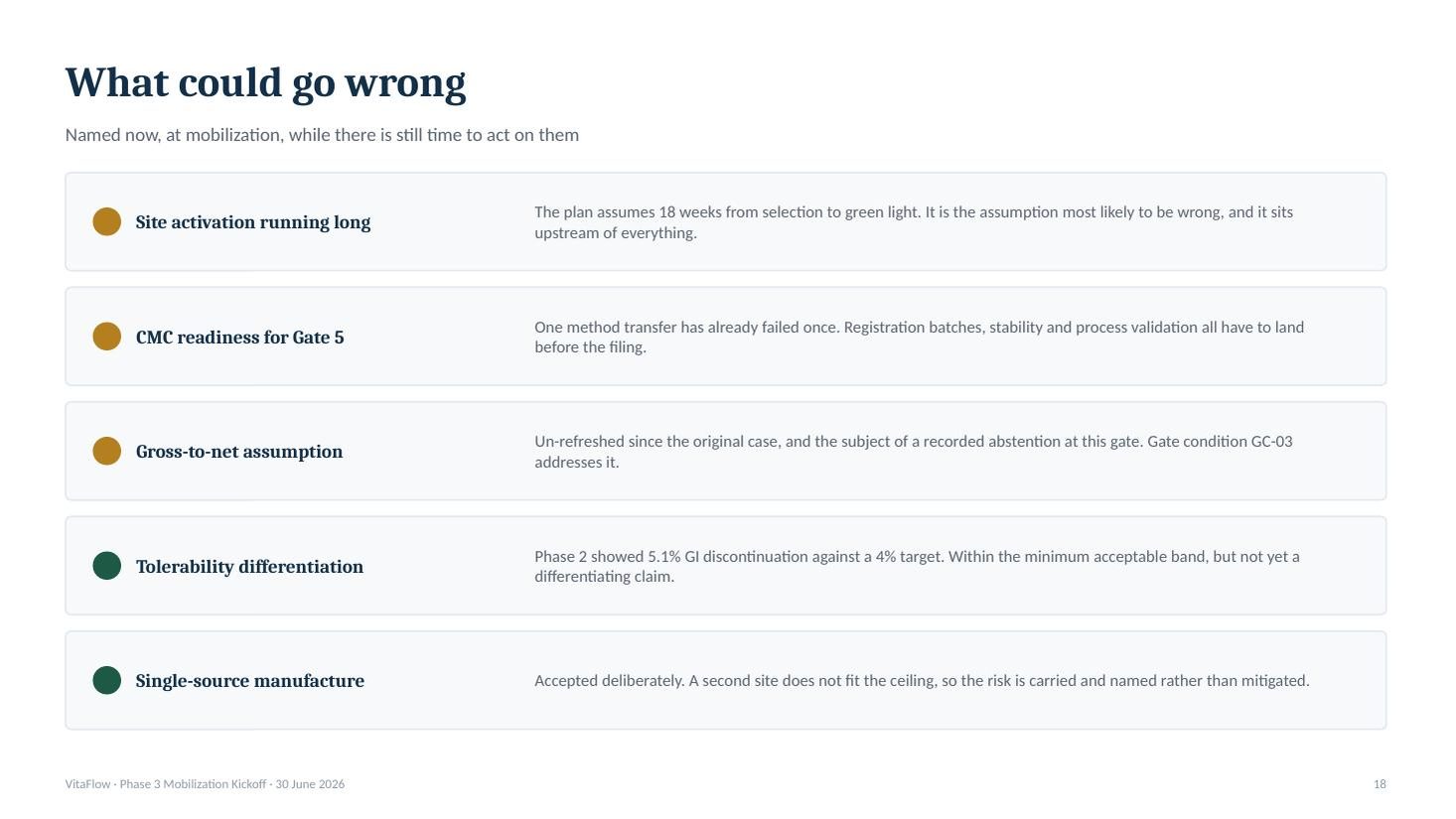
19What could go wrongFive risks named at mobilization.
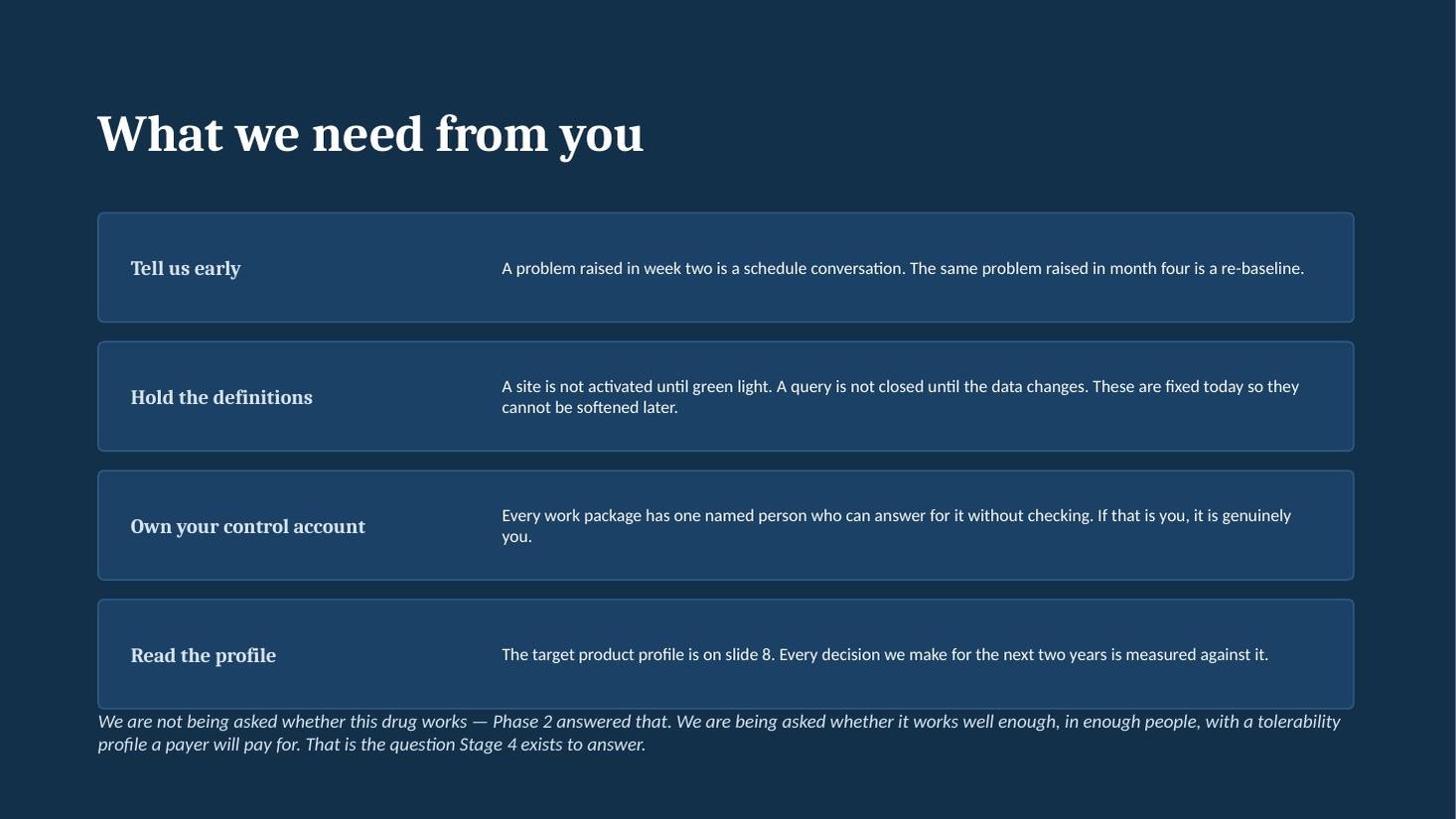
20What we need from youFour asks, and the question Stage 4 answers.

Twenty slides against the steering deck's eleven. The difference is not padding — slides 3 to 10 are history and rationale that the steering deck has no reason to carry, because a Committee that has governed the program for four years does not need to be told what a GLP-1 receptor agonist is.

4. The History Section, and Being Honest In It

Eight of the twenty slides describe things that happened before the audience was assembled. The temptation in that material is to narrate the past as a clean run-up to an obvious decision, and the deck deliberately does not.

What it would be tempting to sayWhat the deck says
We selected the best moleculeWe selected the third-best molecule on tolerability and the second-best on potency, because it was the only one of the three that could be made at commercial scale on existing equipment. Manufacturability decided the candidate.
The business case was compellingAt Gate 0 the risk-adjusted expected value was $96,025,247 against an authorized cost of $243,040,000. The expected value was less than the cost of finding out, which is the whole reason funding arrives in tranches.
We are entering a growing marketWe are fourth into a class where the first two hold preferred formulary position, and a third competitor will file roughly eighteen months ahead of us.
Gate 4 was approvedGate 4 carried with conditions, 5-0-1. The CFO abstained on an un-refreshed gross-to-net assumption, and that abstention is on the record.
A kickoff deck that oversells the position is disarmed the first time reality contradicts it.

Everyone in that room will find out within a year what the actual risks were. If the deck told them the case was compelling and the case was in fact marginal-but-optioned, the deck loses its authority precisely when the program needs people to believe its other statements — about definitions, about escalation, about what is not negotiable.

This is the same discipline as the point-in-time rule elsewhere in the suite. The deck is allowed to be wrong about the future. It is not allowed to be misleading about the present.

The open method-transfer issue is on slide 13 for the same reason. It had already failed once by this date, two of three methods had been re-qualified, and it is why CMC readiness is a gate condition rather than an assumption. Leaving it off would have made the deck more comfortable and less useful.

5. Point-in-Time Discipline

This deck is dated 30 June 2026 and knows nothing after it. That is enforced rather than intended.

Known at Gate 4 — in the deckNot yet known — absent
Phase 2 results, including 5.1% GI discontinuationThat enrolment will run behind curve
The method transfer failure of March 2026That site activation will run 22 weeks against a planned 18
CR-02, the cardiovascular sub-study, approved in AprilThe cost variance on internal labor, and the revised estimate at completion
The three Gate 4 conditions and the CFO's abstentionAnything about the eventual label, pricing or formulary position
The risks slide names site activation as the assumption most likely to be wrong — and it was.

That is not hindsight smuggled in. The risk was genuinely identified at mobilization, with the right mechanism named, and it still materialized. That is what a well-run program looks like from the inside: the failure was foreseen, stated, and happened anyway, because naming a risk is not the same as having a lever against it.

A deck written with knowledge of the outcome would have made that warning look prophetic. Written honestly at its own date, it reads as one of five concerns, ranked amber, alongside four others that did not materialize. That is the more useful document and the more honest one.

Comparing this deck with the steering deck four months later is the clearest illustration of the dual-horizon convention anywhere in the suite: same program, same author, same fact base — and one of them knows about the shortfall.

6. What Building It Caught

The deck passed schema validation on the first build and looked finished. Three separate checks disagreed, and each found something a reader would have seen.

CheckWhat it foundWhy it mattered
Content dump (markitdown)Nothing on this deck — but the same check caught HTML entities rendering literally on the steering deck, which is why every string entering a deck is now stripped and decoded.The fact base is authored for HTML. A slide is not HTML, and the build cannot see the difference.
Geometry (deck_qa.py)Timeline marker labels running off both edges of the canvas, and the gates slide overflowing the bottom by 0.3″.Both would have shipped. PowerPoint writes coordinates past the edge rather than clamping them, so the content is simply not on the slide.
Depth bar (verify_pharma.py)This page below the 1,700-word minimum on first build.The convention is to add the section the artifact was missing rather than pad — which is what this section is.
The label defect is the instructive one, because it is a consequence of the design being correct.

The timeline renderer centers each marker's label underneath its marker. That is right everywhere except at the two ends, where a marker sits at position 0.0 or 1.0 and a centered 2.1-inch label has nowhere to go. The first and last events on every timescale — patent filed and patent expiry, the two dates the whole slide exists to convey — were the ones falling off the page.

The most important element on a diagram is often the one at its edge, and edge cases in layout code hit exactly the content that carries the argument.

All four timescales are drawn by one renderer, so the fix applied to all of them at once. That is the argument for a single code path over four hand-placed diagrams: the bug was in one function, it was found by one check, and it was fixed once.