1. A Deck Is a Meeting Instrument, Not a Document
The status report is the document. It is circulated as a pre-read, it can be paused over, and it carries the detail. This deck exists to run twenty minutes of a Committee meeting, and almost every decision in its design follows from that one difference.
| The report | The deck |
|---|---|
| Read alone, at the reader's pace | Read aloud, at the presenter's pace, once |
| Detail is a virtue — the reader can skip | Detail is a cost — nobody can skip |
| Structured by subject area | Structured by what the meeting has to produce |
| Complete | Sufficient. Anything not needed for a decision belongs in the pre-read. |
| Survives the meeting as the record | Does not. The minutes are the record, and the deck is discarded. |
It is complete, it is structured by function, each area gets a slide whether or not anything has happened in it, and the ask — if there is one — arrives on slide nineteen to an audience that stopped listening at eleven. Completeness is the wrong objective for a document that is read once, out loud, by someone who is also trying to make three decisions.
The test applied here: every slide either supports a decision the Committee has to take, or it is not in the deck. Eleven slides survived it.
2. The Structure
| # | Slide | What it carries |
|---|---|---|
| 1 | Title | Program, committee, stage and date. Nothing else. |
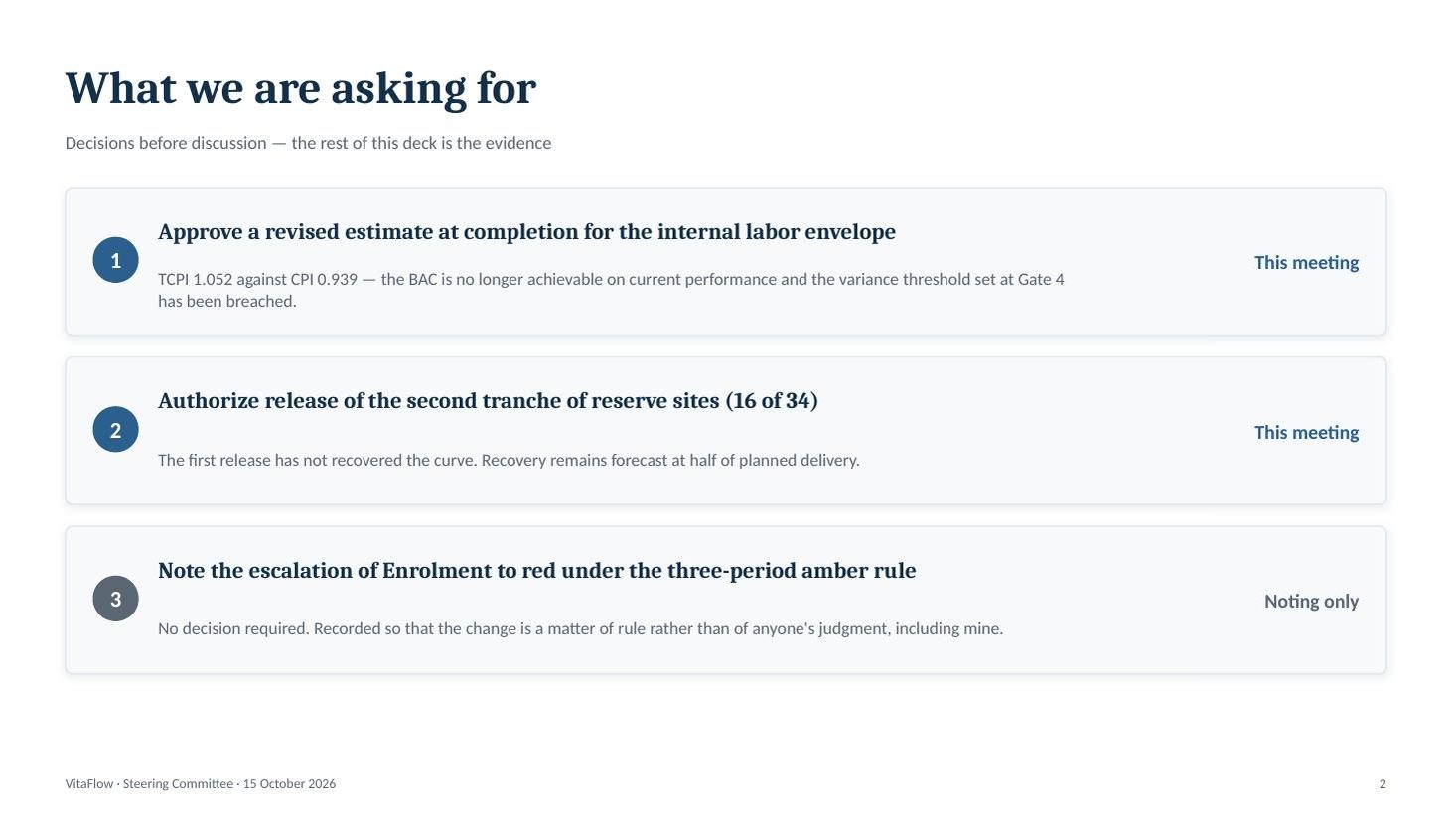
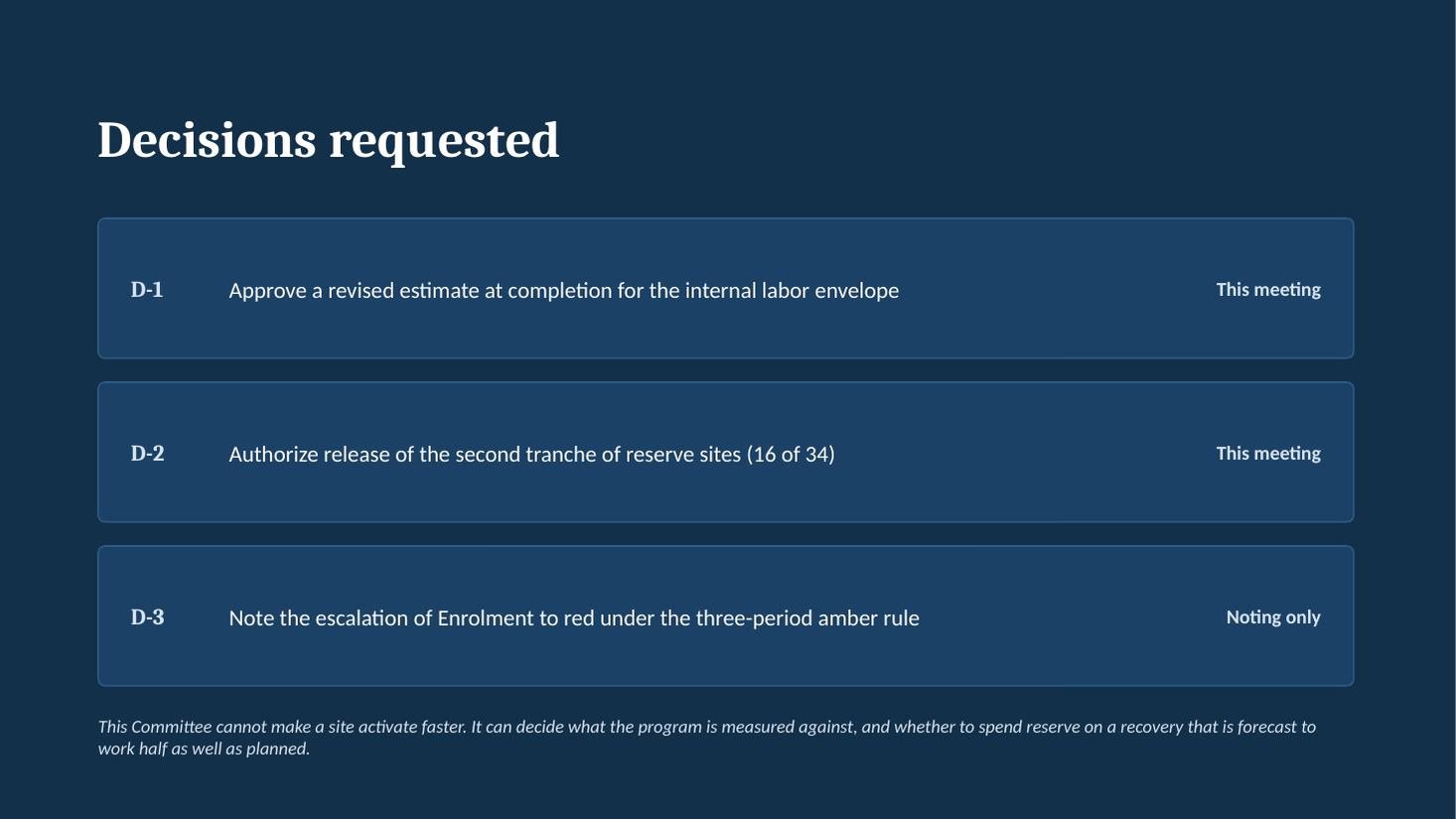
| 2 | What we are asking for | Three decisions, with deadlines, before any evidence. |
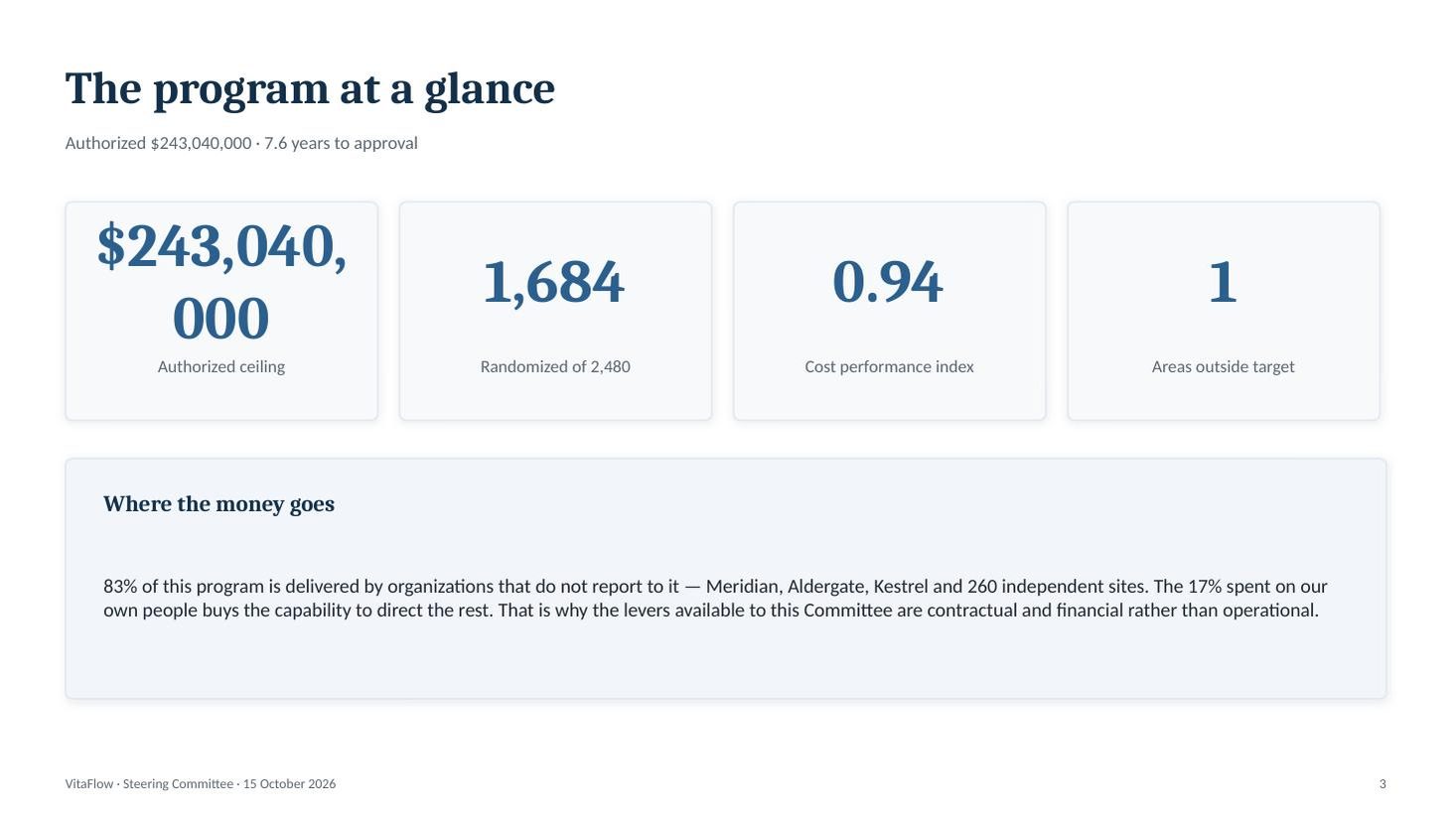
| 3 | The program at a glance | Four figures and the 83/17 framing. |
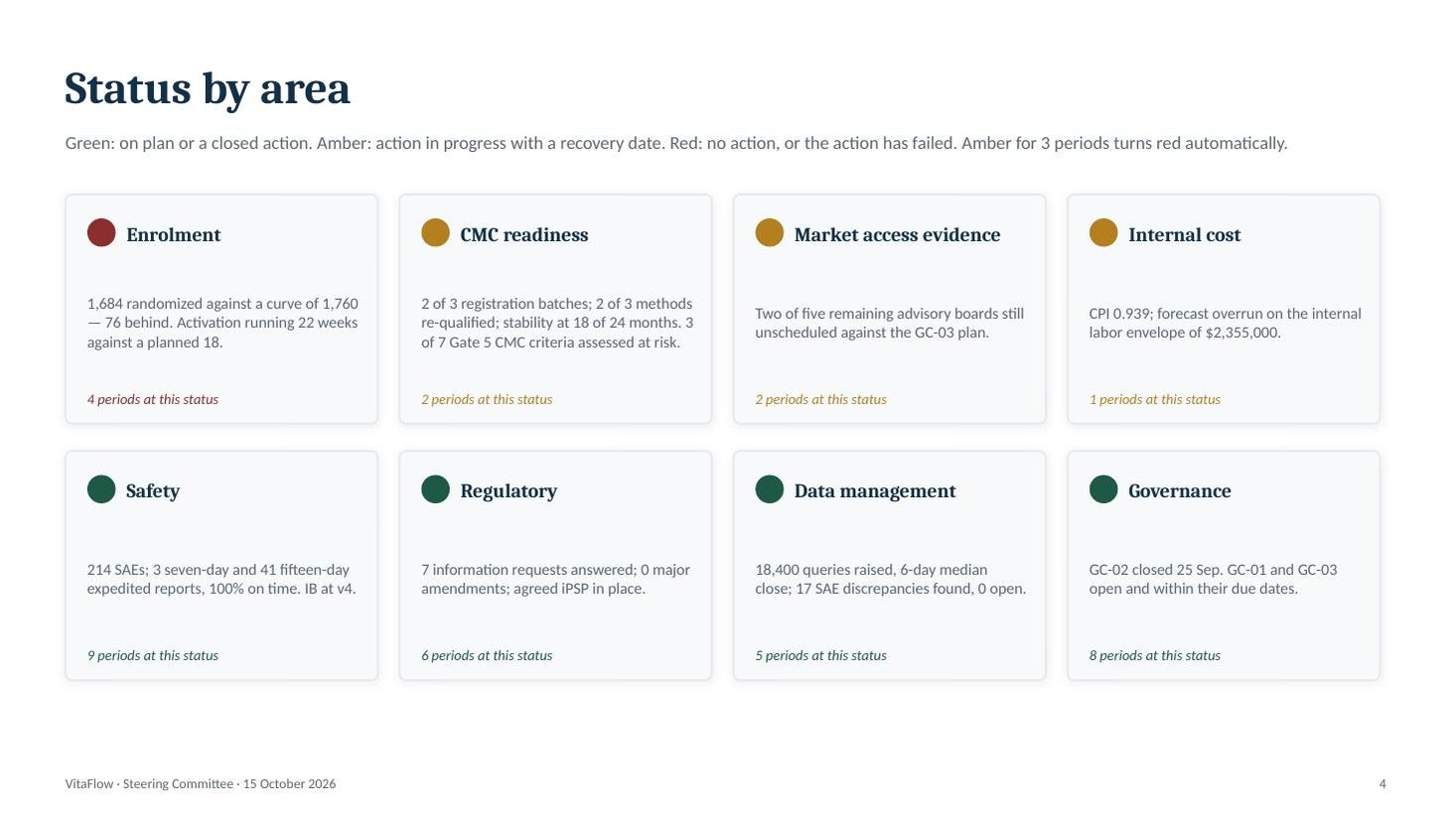
| 4 | Status by area | Eight areas against the RAG rule, with periods at status. |
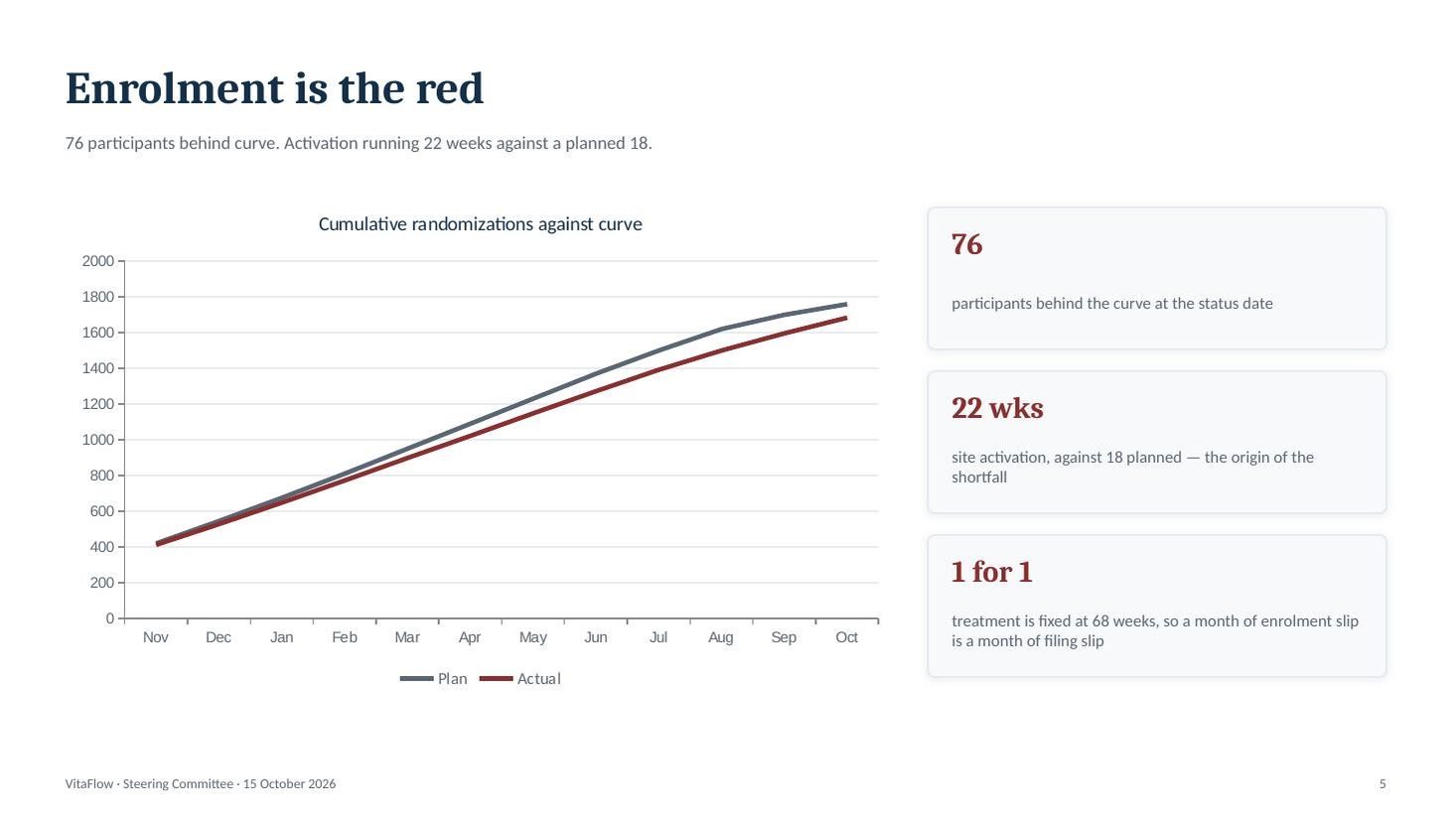
| 5 | Enrolment is the red | Curve versus actual, and the three numbers that matter. |
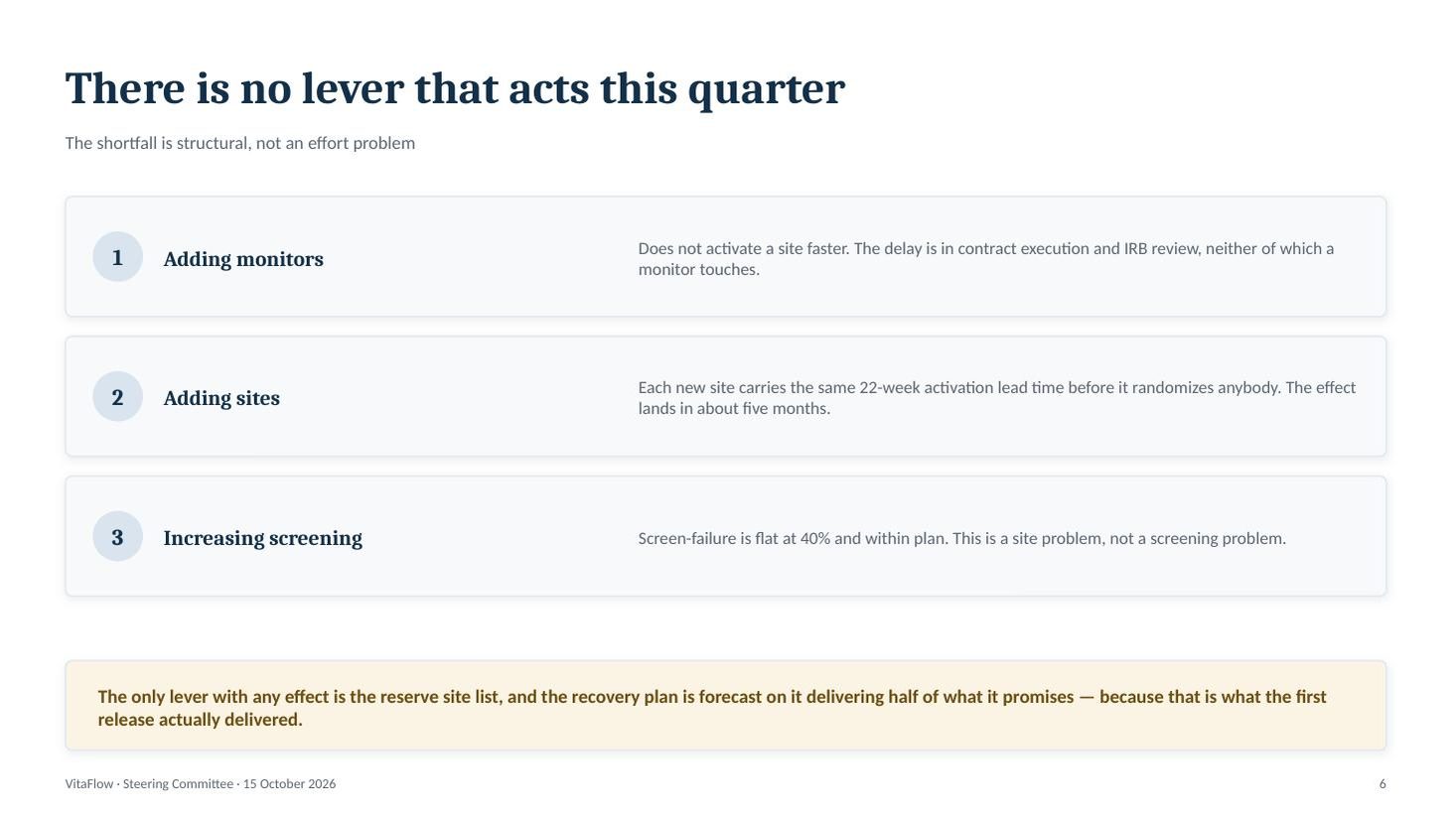
| 6 | There is no lever that acts this quarter | Why effort is not the constraint. |
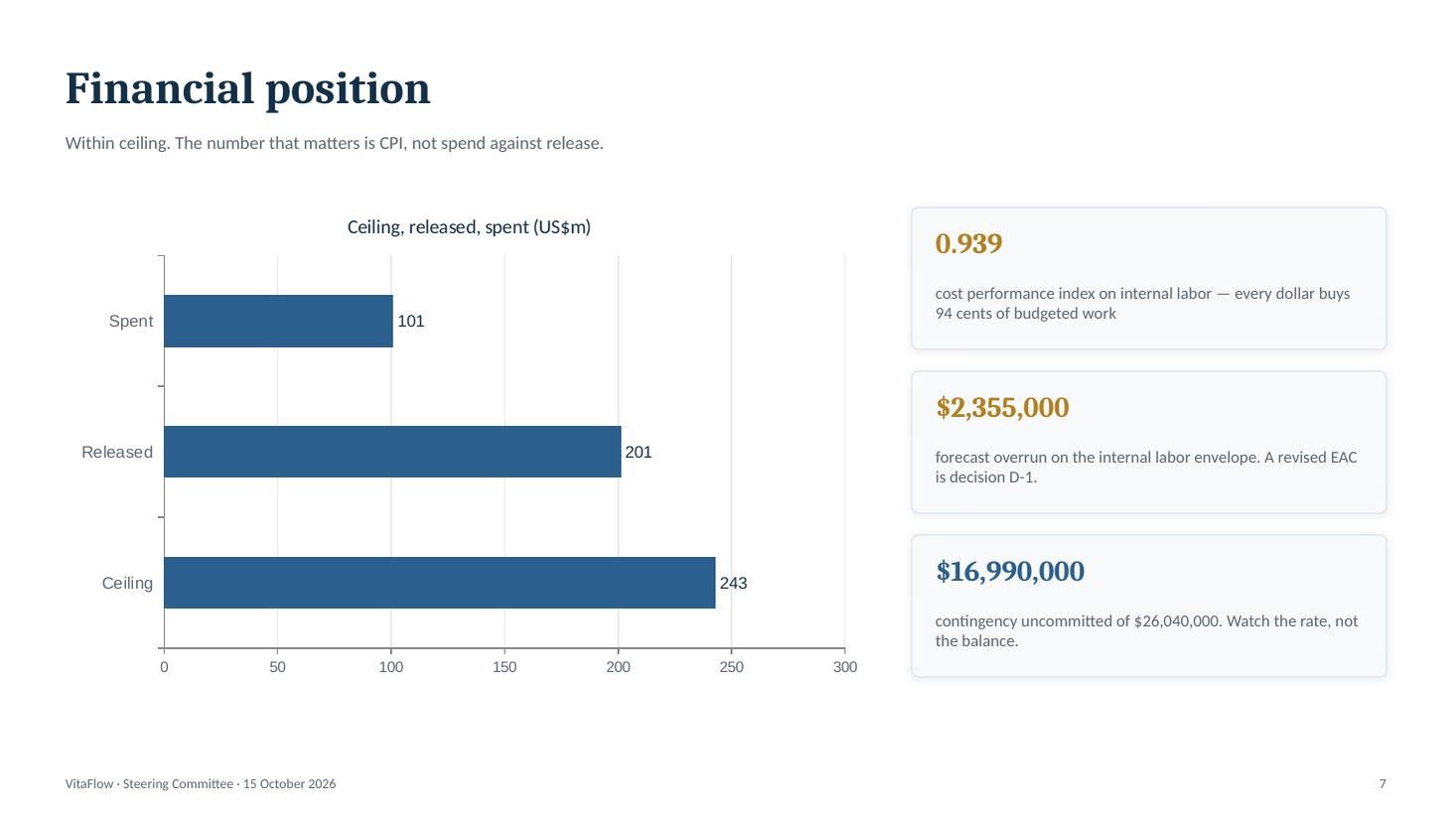
| 7 | Financial position | Ceiling, released, spent — and why CPI is the real number. |
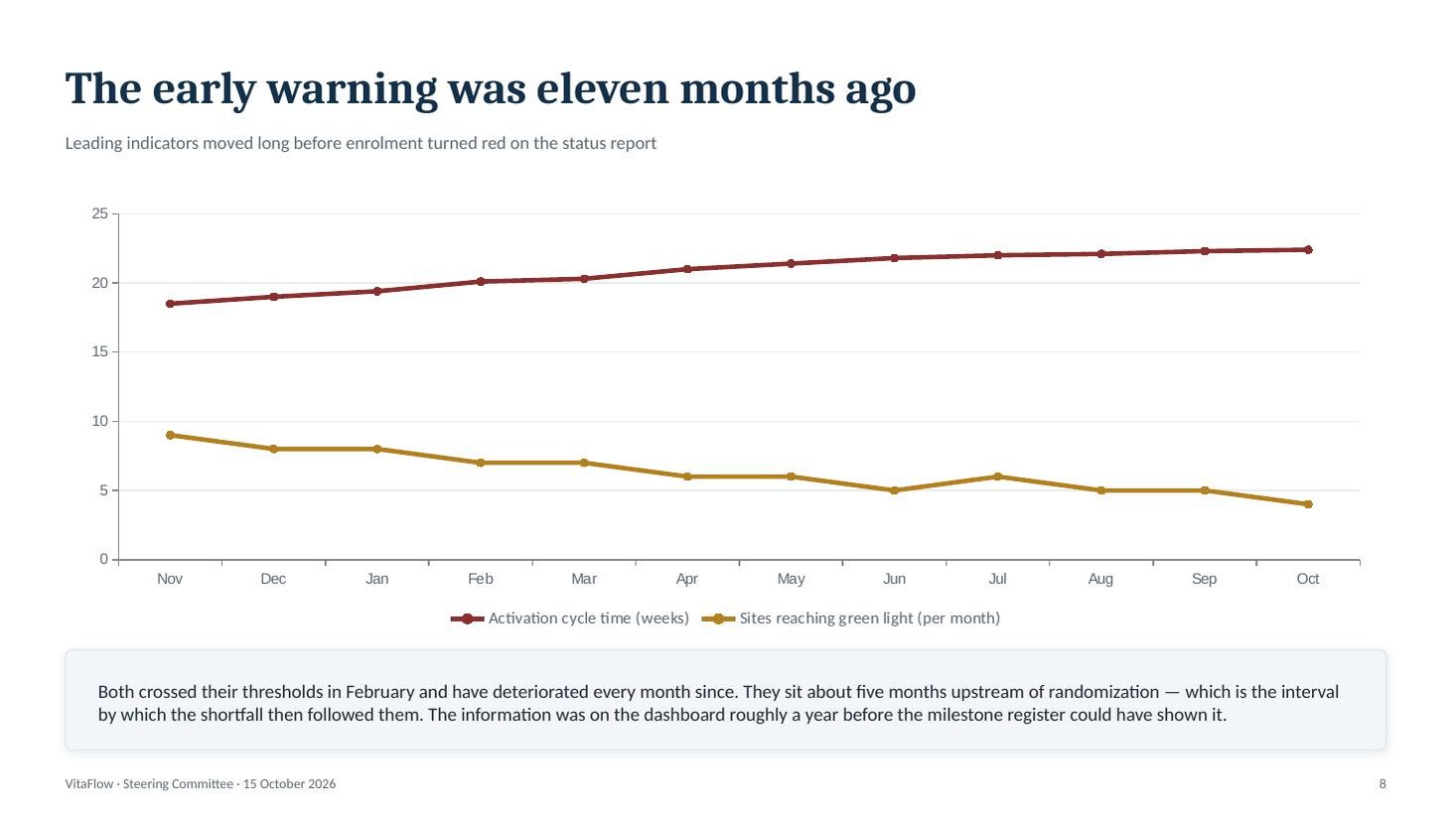
| 8 | The early warning was eleven months ago | The two leading indicators, plotted. |
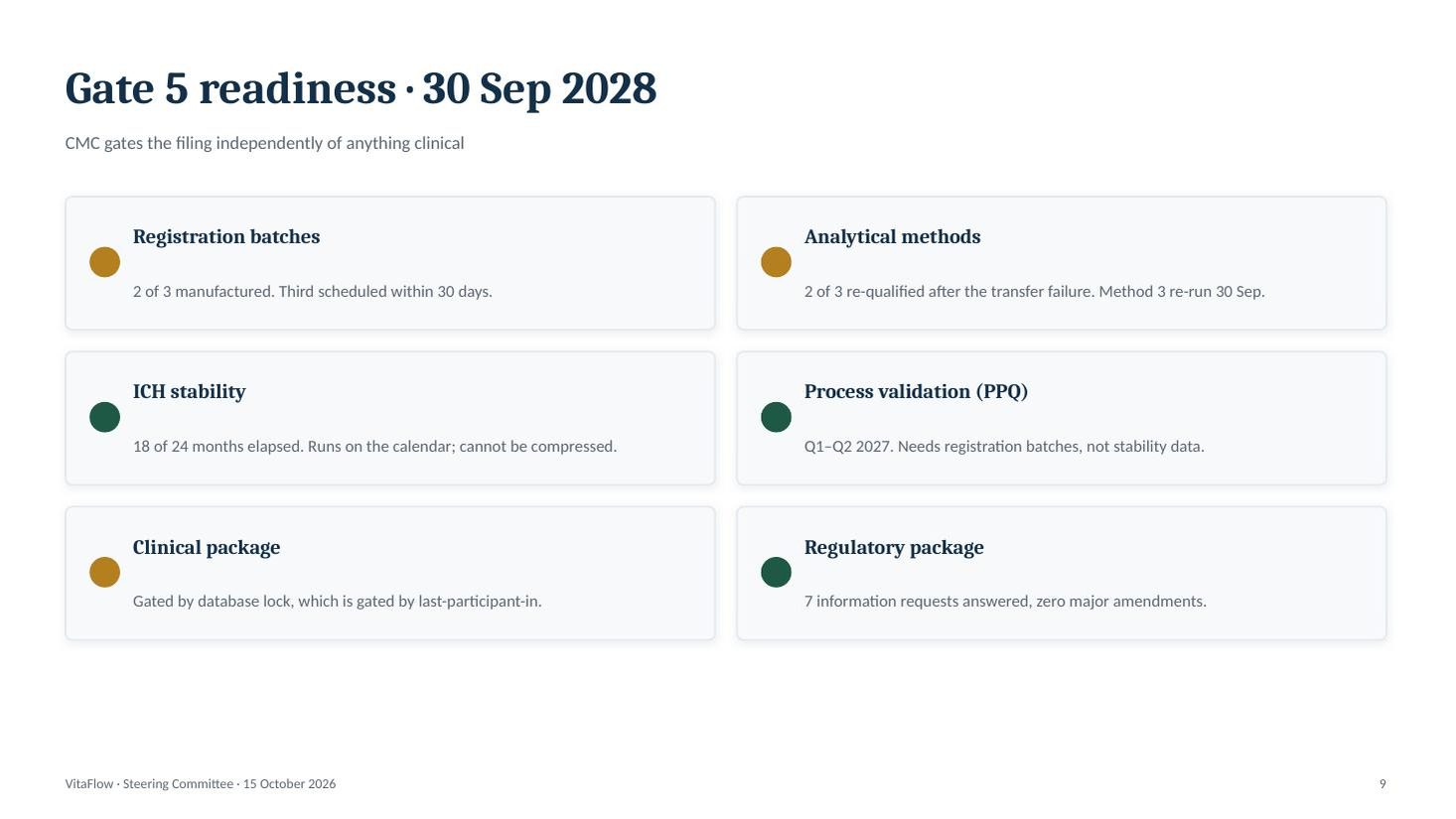
| 9 | Gate 5 readiness | Six criteria, three at risk, CMC on its own path. |
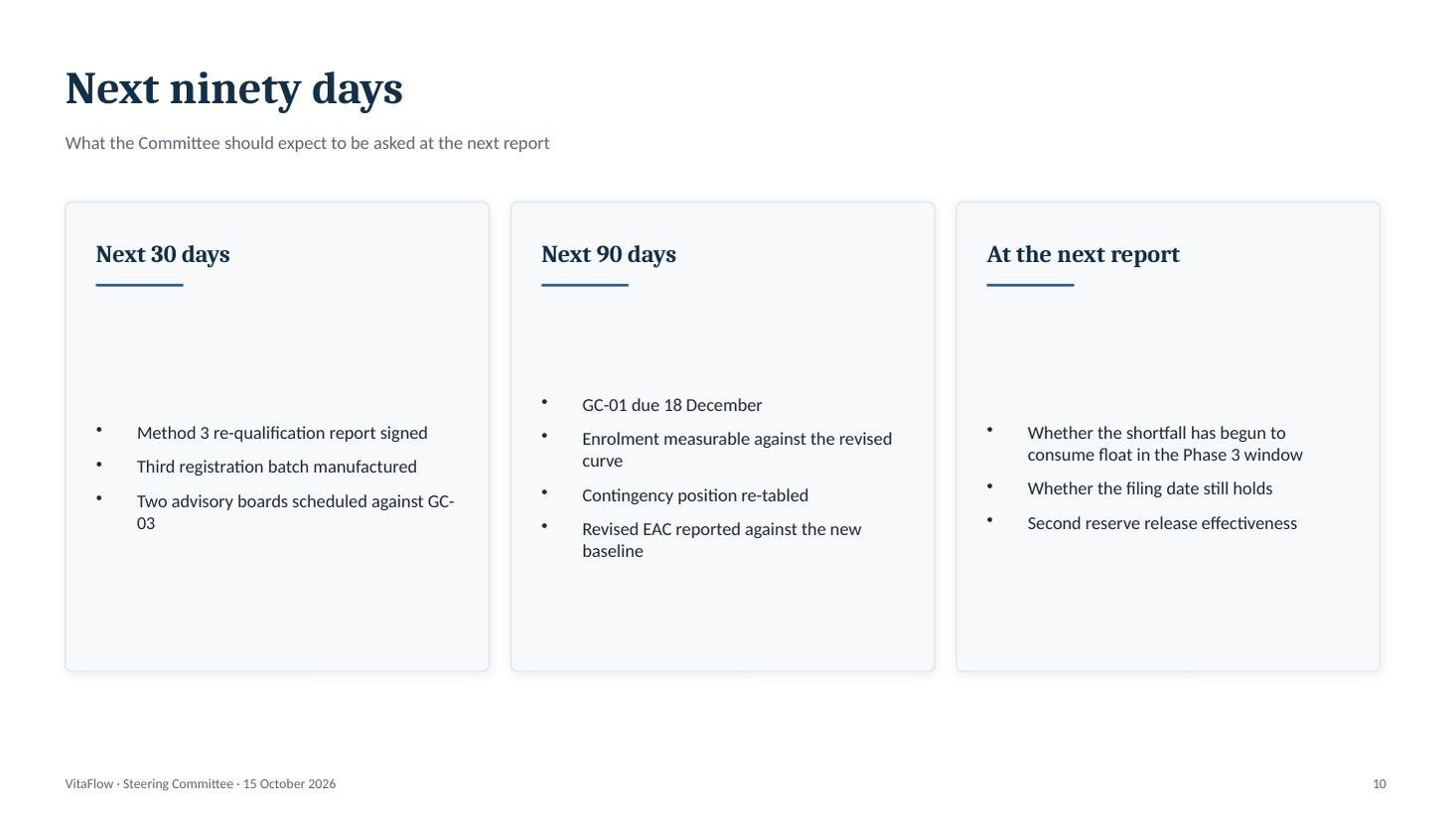
| 10 | Next ninety days | What the Committee will be asked next time. |
| 11 | Decisions requested | The same three, closing. |
That is the one structural choice worth arguing about, because the instinct runs the other way: build the case, then ask. It is wrong for a governance meeting for a specific reason. The Committee's attention is highest in the first five minutes and it is spending it on orientation — working out what this meeting is for. Telling them at the start converts the remaining fifteen minutes from a briefing into an evaluation, which is what they are there to do.
It also has a useful failure mode. If the Committee agrees both decisions on slide 2, the deck is over and the meeting gives twelve minutes back. A deck that cannot end early is a deck whose author wanted to present rather than to be answered.
3. What Is On the Slides, and Where It Came From
Nothing in the deck is typed. Every figure is read from the same fact base as every other artifact in this suite, which is what makes the deck safe to hand to somebody else.
| Slide | Source | Why it matters that it is derived |
|---|---|---|
| Decisions | Status report — the same DECISIONS_REQUESTED register | The deck cannot ask for something the written report does not. |
| Status by area | The same eight areas and the same RAG rule | A deck that colored an area differently from the report would be the more dangerous of the two documents, because it is the one people remember. |
| Enrolment curve | The locked enrolment facts | The final actual point is asserted equal to 1,684 and the final plan point to 1,760. A chart that drifted from the register would fail the build. |
| Financial position | Budget and performance baseline | CPI and the forecast overrun are the same numbers the EAC decision rests on. |
| Leading indicators | Dashboard series LI-1 and LI-2 | The deck plots the identical twelve-month series, not a redrawn approximation. |
Somebody needs a version for a different audience, copies the file, edits a number, and there are now two decks. Six months later nobody can say which figure was tabled. Generating the deck from the fact base does not prevent that — anyone can still edit the output — but it means the canonical deck is reproducible from a command, and any hand-edited copy can be diffed against it.
The fact that this deck's charts are native PowerPoint objects rather than pasted images is part of the same argument. A pasted image cannot be checked against anything.
4. The Pre-Read Material
Each of these appears in a written artifact and was deliberately kept out of the deck.
| Left off | Where it lives | Why not on a slide |
|---|---|---|
| The full milestone register | Milestone plan | Twenty-eight rows is a reference table. On a slide it is unreadable, and reading it aloud would consume the meeting. |
| Every risk in the register | RAID log | The Committee is not asked to decide anything about most of them. The two that bear on the decisions appear inside the relevant slides. |
| The WBS and cost pools | WBS and budget | Structure, not status. It belongs in the pre-read for anybody who wants to check the decomposition. |
| The DMC position | DMC charter | ⚠ Not the Committee's to discuss. Safety sits outside its authority, and putting it on a governance slide invites exactly the conversation the structure exists to prevent. |
| Anything after Gate 5 | The delivery artifacts | This deck speaks as at 15 October 2026. Forecasts beyond the next gate are noise at a checkpoint. |
The fourth row is the one that carries a principle rather than a preference. A steering deck should not contain material the steering body has no authority over, however interesting it is. Including the DMC's position would be informative, would be well received, and would slowly erode the boundary that makes the DMC's independence real.
5. The Deck as a Deliverable
The download on this page is a genuine .pptx — eleven slides, native
PowerPoint charts, speaker notes on every slide — generated from the fact base rather than
converted from this page. It is the only artifact in the suite whose deliverable is not produced by
the standard HTML-to-Office converter.
| Property | Detail |
|---|---|
| Slides | 11, on a 13.3″ × 7.5″ canvas |
| Charts | Native PowerPoint objects — a line chart for enrolment, a bar chart for the financial position, a two-series line for the leading indicators. Editable in PowerPoint, and checkable against the source. |
| Speaker notes | On every slide. They carry the things the presenter needs and the slide must not say — where to expect a challenge, and what not to reopen. |
| Checks run | OOXML schema validation, a content dump for entity and placeholder leakage, and a geometric pass over every shape for off-canvas placement, margins and overlaps. |
The fact base is authored for HTML, so the first build rendered
— and
<b> literally on the slides — invisible to the build, obvious to an
audience. Every string entering the deck is now stripped of markup and decoded.The second was subtler and was in the check rather than the deck: the first geometric pass counted the slide's own group transform as content and reported a zero margin on all eleven slides, then flagged twenty-five “overlaps” that were text boxes correctly sitting inside their cards. A QA script that reports failures on a correct file is worse than no QA script, because the next real failure arrives in a list you have learned to ignore.
The deck builder is the suite's first dependency outside Python — it needs
node and pptxgenjs. The build degrades rather than fails when they are
absent: it warns, keeps any existing deck, and the standing link check catches a missing file. A
package that will not rebuild at all because one optional toolchain is missing has made a
convenience into a hard dependency.
6. Presenting It
The deck is built for twenty minutes and a room of seven, one of whom chairs it and has no vote. The allocation below is on the speaker notes rather than in anyone's head, because a checkpoint that overruns takes its overrun out of the decisions.
| Minutes | Slides | What is happening |
|---|---|---|
| 0–1 | 1 | Orientation. Which program, which stage, which date. |
| 1–5 | 2 | The ask. Read all three, then stop and let the Committee respond. If both decisions carry here, skip to slide 9. |
| 5–9 | 3–4 | Context and the RAG position. Fast — this is the part the pre-read already covered. |
| 9–15 | 5–8 | The evidence for D-2. Enrolment, why effort is not the lever, the money, and the leading indicators. |
| 15–18 | 9–10 | Gate 5 exposure and what arrives next report. |
| 18–20 | 11 | Close on the ask. Confirm what was decided, in the words the minutes will use. |
Three notes in this deck are prohibitions rather than prompts: do not let slide 5 become a discussion about trying harder; do not reopen enrolment on slide 11; expect the challenge on adding sites and answer it with the five-month lead time rather than with willingness. Each marks a place where a reasonable-sounding conversation would consume the meeting and produce nothing.
A presenter who has decided in advance which conversations to decline is the difference between a checkpoint that takes two decisions and one that takes none.
One deliberate omission from the notes: there is no script. The notes carry timing, the challenges to expect, and the boundaries — not sentences to read. A steering committee can tell when it is being read to, and the effect on a room of people whose job is to interrogate the program is the opposite of the one intended.
Finally, the chair does not present. C. Tyrrell chairs the Committee and has no vote, and the same separation applies in the room: the Program Director tables the position and the decisions, and the Committee's own members carry the discussion. A deck presented by the person who also counts the votes is a briefing with a governance label on it.